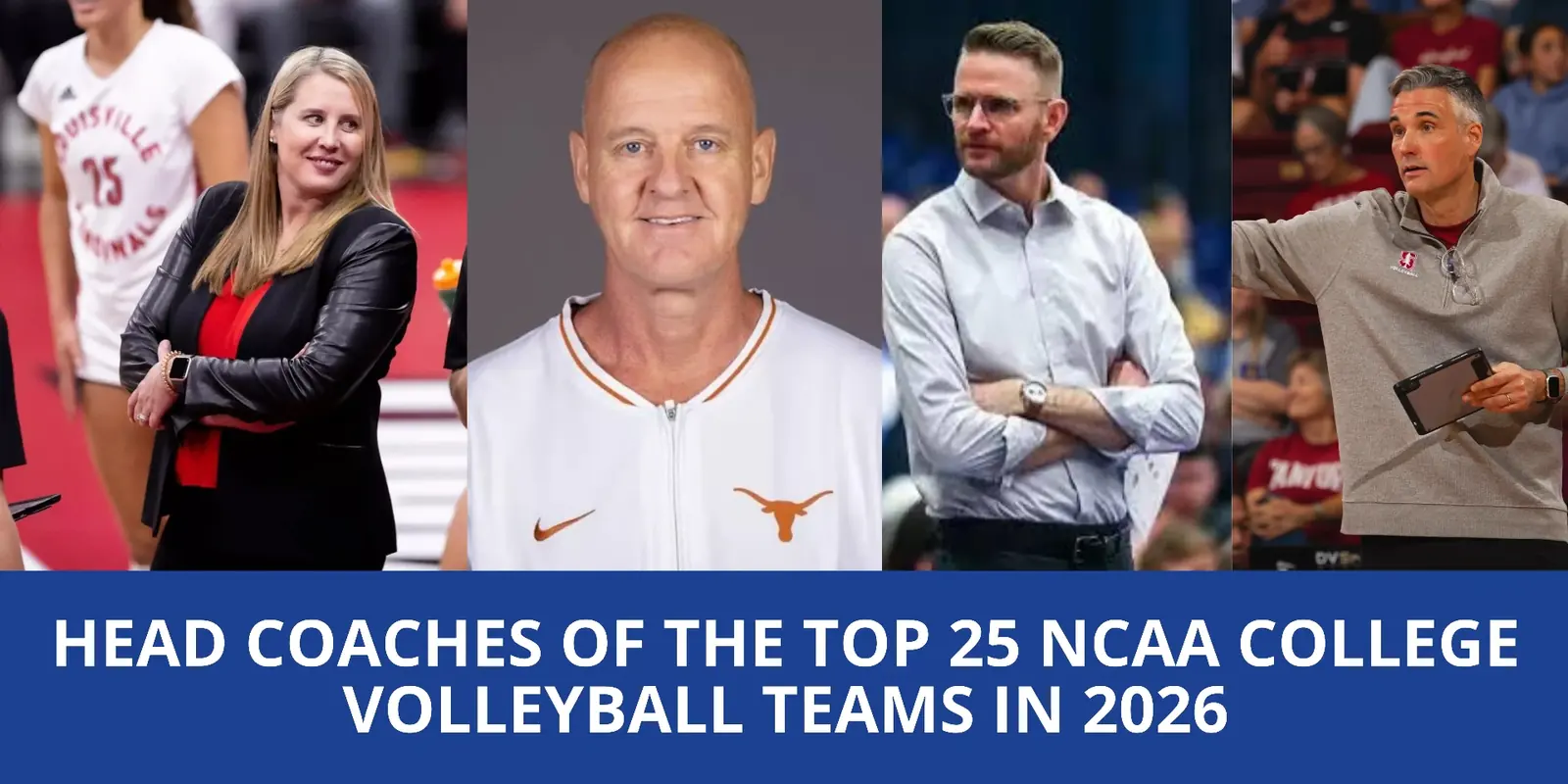
The Head Coaches of the Top 25 NCAA College Volleyball Teams in 2026 tell us a lot about where the sport is going. The best programs are not built only on star outside hitters or tall middle blockers. They're usually built around steady leadership, recruiting, player development, smart scheduling, and a clear volleyball identity.
For this 2026 look, the safest approach is to use the latest available national top-25 reference and then match each program with its current head coach. Rankings, schedules, rosters, and staff roles can change, so fans should always check official school athletic sites and AVCA updates before relying on any list as final.
That said, this group gives volleyball fans a strong picture of the coaches shaping the national conversation.
Head Coaches of the Top 25 NCAA College Volleyball Teams in 2026
At first glance, a head coach list may look simple: school, coach, conference. The reality is more interesting. Some coaches are long-time program builders. Some are newer hires taking over elite expectations. Others are turning historically solid programs into true national threats.
Here's a quick reference table.
| Rank | Team | Conference | Head Coach | Program Note |
|---|---|---|---|---|
| 1 | Texas A&M | SEC | Jamie Morrison | National-title level momentum |
| 2 | Kentucky | SEC | Craig Skinner | One of the SEC's most stable powers |
| 3 | Nebraska | Big Ten | Dani Busboom Kelly | New era after John Cook |
| 4 | Pittsburgh | ACC | Dan Fisher | National semifinal standard |
| 5 | Wisconsin | Big Ten | Kelly Sheffield | Elite recruiting and physical style |
| 6 | Texas | SEC | Jerritt Elliott | Proven championship coach |
| 7 | Stanford | ACC | Kevin Hambly | Talent-rich national brand |
| 8 | Purdue | Big Ten | Dave Shondell | Consistent Big Ten contender |
| 9 | Louisville | ACC | Dan Meske | Promotion after major success cycle |
| 10 | Creighton | Big East | Brian Rosen | New leadership after Booth era |
| 11 | SMU | ACC | Sam Erger | Fast-rising national program |
| 12 | Arizona State | Big 12 | JJ Van Niel | One of the sharpest recent turnarounds |
| 13 | Indiana | Big Ten | Steve Aird | Program-building progress |
| 14 | Kansas | Big 12 | Matt Ulmer | New coach replacing a legend |
| 15 | Minnesota | Big Ten | Keegan Cook | Modern Big Ten rebuild |
| 16 | Miami | ACC | Jose "Keno" Gandara | Experienced ACC leadership |
| 17 | USC | Big Ten | Brad Keller | Historic program in a new conference era |
| 18 | TCU | Big 12 | Jason Williams | Rising Big 12 profile |
| 19 | North Carolina | ACC | Mike Schall | Steady upward movement |
| 20 | Baylor | Big 12 | Ryan McGuyre | Player-development reputation |
| 21 | Cal Poly | Big West | Caroline Walters | Mid-major program with national bite |
| T-22 | Colorado | Big 12 | Jesse Mahoney | Big 12 growth opportunity |
| T-22 | Iowa State | Big 12 | Christy Johnson-Lynch | Long-term program builder |
| 24 | Tennessee | SEC | Eve Rackham Watt | SEC program with tournament upside |
| 25 | BYU | Big 12 | Rob Neilson | New era after Heather Olmstead |
Why Head Coaches Matter So Much in College Volleyball
In football and basketball, fans often talk about coaching every day. Volleyball fans sometimes focus more on hitters, setters, and liberos. I think that misses a big part of the story.
In practice, a college volleyball coach affects almost everything:
- Recruiting style
- Serving and passing identity
- Setter development
- Transfer portal decisions
- Defensive system
- Match scheduling
- Locker-room culture
- How freshmen are developed
- Late-season lineup changes
One thing many people overlook is how hard it is to keep a volleyball team balanced. A coach may have five elite attackers, but only one ball. A team may have size at the net, but poor first contact. Another team may have a great libero, but no reliable opposite.
That's where coaching shows up.
The best NCAA volleyball coaches don't just collect talent. They build a system where the talent makes sense together.
The Championship Tier: Programs Built for Deep Runs
Jamie Morrison, Texas A&M
Jamie Morrison leads Texas A&M at a time when the Aggies are no longer just trying to prove they belong. They're part of the national-title conversation.
Morrison's background is especially interesting because he has experience beyond the college game. From what I've seen, coaches with high-level national team or professional experience often bring a different level of detail to training. They tend to think deeply about serve pressure, transition scoring, and how players handle long rallies.
For Texas A&M fans, the big question is simple: can the Aggies turn one great run into a lasting national standard?
Craig Skinner, Kentucky
Craig Skinner is one of the clearest examples of long-term program building. Kentucky volleyball has become a yearly SEC power under his leadership.
The biggest misconception is that Kentucky's success is only about athleticism. Athleticism matters, of course. But Skinner's teams usually look organized, tough, and comfortable in big matches. That doesn't happen by accident.
Kentucky is often at its best when it controls the serve-and-pass battle. That gives its setters cleaner options and allows the offense to stay balanced.
Dani Busboom Kelly, Nebraska
Nebraska is one of the biggest brands in college volleyball, and Dani Busboom Kelly stepped into one of the most watched jobs in the sport.
That kind of transition is not easy. Many people assume a winning program simply keeps winning. But replacing a legendary coach brings pressure, emotion, and constant comparison.
Busboom Kelly's advantage is that she understands Nebraska volleyball from the inside. She played there, coached at a high level, and already has head-coaching experience from Louisville. In real-world situations, that background can help a coach manage expectations without running away from them.
Dan Fisher, Pittsburgh
Dan Fisher has made Pitt one of the most reliable national powers in women's college volleyball.
Pitt's rise matters because it shows that elite volleyball is not limited to a small group of traditional brands. Fisher's teams have been athletic, well-prepared, and confident against top competition.
A common mistake I see is treating Pitt as a "new" contender. That's outdated thinking. Pitt has been good long enough that fans should view the Panthers as a serious national program.
Kelly Sheffield, Wisconsin
Kelly Sheffield's Wisconsin teams are usually physical, disciplined, and difficult to break down.
Wisconsin volleyball often feels like a program with a clear identity. The Badgers want strong blocking, efficient attacking, and a home-court atmosphere that puts pressure on opponents.
If I were making a short list of coaches who understand how to build a yearly national contender, Sheffield would be on it.
Proven Veterans Still Shaping the National Race
Jerritt Elliott, Texas
Jerritt Elliott is one of the most successful active coaches in the sport. Texas expects to compete for championships, and that expectation can be heavy.
What surprises many people is how difficult it is to stay elite after winning. Every opponent circles the match. Every recruiting miss gets noticed. Every roster change becomes a story.
Elliott's value is not just that he has won. It's that Texas has continued to operate with championship standards across different roster cycles.
Kevin Hambly, Stanford
Kevin Hambly leads a Stanford program with a national reputation for elite talent and high academic standards.
Stanford is not just recruiting volleyball players. It is recruiting athletes who can handle one of the most demanding university environments in the country. That creates a different coaching challenge.
Hambly's teams are often at their best when they combine size, skill, and controlled tempo.
Dave Shondell, Purdue
Dave Shondell has made Purdue a respected Big Ten force.
The Big Ten is a brutal volleyball league. There are very few easy nights. That makes consistency more valuable than people realize.
Purdue under Shondell has often been the kind of team that no national seed wants to see in December. They're physical, experienced, and usually well-coached in tight sets.
New-Era Coaches Taking Over Big Expectations
Dan Meske, Louisville
Dan Meske moved into the Louisville head-coaching role after the Cardinals had already become a national-level program.
That can be tricky. A coach taking over a struggling team gets time to build. A coach taking over a winning team gets judged immediately.
Meske's familiarity with Louisville should help. He was already part of the program's rise, so this is more of a continuation than a complete restart.
Brian Rosen, Creighton
Creighton's move to Brian Rosen is another important transition.
Kirsten Bernthal Booth built Creighton into a national name. Replacing that kind of figure is never simple. Still, internal continuity can matter. Players don't have to learn a completely new culture overnight.
Creighton fans should watch how Rosen handles roster development and late-season tournament preparation.
Matt Ulmer, Kansas
Kansas also entered a new chapter with Matt Ulmer.
Ray Bechard was closely tied to Kansas volleyball for decades. That means Ulmer's job is about more than tactics. It's about respecting the past while building a modern version of the program.
Based on my experience following coaching transitions, the first two seasons often tell us a lot. Not always in wins and losses, but in recruiting direction, staff structure, and player buy-in.
Rob Neilson, BYU
BYU's 2026 season is also a fresh start with Rob Neilson.
Heather Olmstead set an extremely high standard at BYU. Neilson brings a strong coaching background and returns to a program that expects NCAA Tournament volleyball.
The key will be how quickly BYU builds a new identity in the Big 12. The league is deep, physical, and demanding.
Fast-Rising Programs Fans Should Watch
Sam Erger, SMU
SMU has become one of the most interesting stories in college volleyball.
Sam Erger has helped push the Mustangs into a much bigger national conversation. Moving through a stronger conference landscape adds difficulty, but it also gives SMU more chances for ranked wins.
Here's where things get interesting: programs like SMU can change the national map. If they recruit well and keep winning, they stop being a surprise.
JJ Van Niel, Arizona State
JJ Van Niel has quickly made Arizona State relevant on the national stage.
Arizona State's improvement has not felt random. The Sun Devils have played with confidence and structure, which usually reflects strong coaching.
Van Niel's path is also a reminder that great coaches don't always come from the same background. Sometimes the best program builders are people who waited years for the right head-coaching chance.
Steve Aird, Indiana
Steve Aird has worked to raise Indiana's ceiling in a very tough Big Ten environment.
In my experience, Big Ten rebuilds require patience. You can improve a lot and still face elite opponents every week. That's why Indiana's progress matters. It shows the program is becoming more than a tough out.
Keegan Cook, Minnesota
Keegan Cook is trying to guide Minnesota through a modern Big Ten reset.
Minnesota has history, fan support, and recruiting appeal. Still, the Big Ten has become deeper, and the margin between good and elite is small.
Cook's challenge is building a team that can handle long conference stretches without losing its identity.
Experienced Coaches Keeping Their Programs Relevant
Jose "Keno" Gandara, Miami
Jose "Keno" Gandara gives Miami steady leadership in the ACC.
Miami can be a dangerous program because of its athletic profile and location. The challenge is consistency. In a league with Pitt, Stanford, Louisville, and North Carolina pushing upward, every roster decision matters.
Brad Keller, USC
Brad Keller leads USC in a new Big Ten environment.
That is a major shift. USC has deep volleyball history, but travel, conference style, and weekly matchups look different now. Sometimes fans underestimate how much conference realignment affects volleyball.
Long road trips, recovery time, and scouting depth can all influence results.
Jason Williams, TCU
Jason Williams has helped TCU become more competitive in the Big 12.
The Horned Frogs are not just a schedule filler. They've become a program that can challenge strong opponents, especially when their serve receive and transition game are clean.
Mike Schall, North Carolina
Mike Schall has pushed North Carolina in a positive direction.
The Tar Heels have a proud athletic brand, and volleyball has room to keep growing. Schall's next step is turning strong seasons into repeatable national relevance.
Ryan McGuyre, Baylor
Ryan McGuyre has built Baylor into one of the more respected programs in the Big 12.
Baylor's best teams often show strong player development. That matters because not every successful program relies only on the biggest recruiting names. Sometimes the difference is how much players improve from year one to year three.
Coaches Outside the Biggest Brands Who Deserve Attention
Caroline Walters, Cal Poly
Caroline Walters gives Cal Poly a strong identity.
Cal Poly may not carry the same national brand power as Nebraska, Texas, or Stanford, but that doesn't mean the Mustangs are easy to play. Strong mid-major programs can be dangerous in the NCAA Tournament because they're used to playing with belief and rhythm.
Jesse Mahoney, Colorado
Jesse Mahoney has experience and stability at Colorado.
Colorado's Big 12 path gives the program a chance to grow through tough weekly competition. That said, the league is unforgiving. A program can play well and still struggle if it doesn't handle serve receive and blocking matchups.
Christy Johnson-Lynch, Iowa State
Christy Johnson-Lynch is one of the long-term builders in the sport.
Iowa State has often been competitive because of structure, defense, and player development. Long-tenured coaches can create program habits that last beyond one recruiting class.
Eve Rackham Watt, Tennessee
Eve Rackham Watt has pushed Tennessee into a stronger position in the SEC.
The SEC has become a more serious volleyball league. Kentucky, Texas, Texas A&M, Florida, Tennessee, and others make the conference deeper than many casual fans realize.
For Tennessee, the next step is turning strong seasons into deeper NCAA Tournament runs.
Common Mistakes Fans Make About Volleyball Coaches
Mistake 1: Judging Coaches Only by One Season
Volleyball can change quickly. Injuries, transfers, setter changes, and freshman development all affect results.
One bad year doesn't always mean bad coaching. One great year doesn't always prove a dynasty.
Mistake 2: Ignoring Assistant Coaches
Head coaches get the headlines, but assistant coaches matter a lot.
They often lead recruiting, scouting, blocking systems, setter training, and film work. A detail that's easy to miss is how often a staff change affects a team's style.
Mistake 3: Assuming Rankings Are Permanent
Rankings are snapshots. They are not guarantees.
A team ranked in the top 10 can fall fast if it loses ball control. A team outside the top 25 can become dangerous if a young setter matures.
Mistake 4: Forgetting About Conference Strength
A 22-win record in one conference may not mean the same thing as a 22-win record in another.
The Big Ten, SEC, ACC, and Big 12 all bring different challenges. Travel, depth, and physical style can shape a coach's season.
Important Notes for 2026 Volleyball Fans
Rules, schedules, rankings, rosters, and coaching staffs may change over time. The transfer portal can also reshape teams quickly.
Before publishing or updating a team page, check:
- Official school athletics staff directory
- Official volleyball roster page
- AVCA rankings
- NCAA rankings page
- Conference volleyball pages
- Recent school press releases
This is especially important for programs with recent coaching changes, such as Nebraska, Louisville, Creighton, Kansas, and BYU.
Key Takeaways: Head Coaches of the Top 25 NCAA College Volleyball Teams in 2026
The Head Coaches of the Top 25 NCAA College Volleyball Teams in 2026 show how competitive the sport has become. Championship programs like Texas, Nebraska, Kentucky, Wisconsin, Pitt, and Texas A&M still carry major weight, but newer stories are pushing into the spotlight.
SMU, Arizona State, Indiana, TCU, North Carolina, and Cal Poly show that the national map is expanding. Coaching matters more than ever because roster movement is faster, conference travel is tougher, and fans expect results immediately.
If you're following the 2026 NCAA volleyball season, don't just watch the stars. Watch the coaches. Their lineup choices, serving plans, substitutions, and player development will shape the race long before December.
Track Your Team All Season
Schedules, rosters, and rankings for every top-25 program.