
Volleyball Basics
College Volleyball Positions Explained: Who Does What?
Sources reviewed .
The main college volleyball positions are setter, outside hitter, opposite, middle blocker, libero and defensive specialist. Six players are on the court for a team at once, so a roster's list of roles is not a list of six permanently assigned court squares.
That distinction is the key to understanding the game. Rotation describes the service order and front-row or back-row status. A position describes the work a player specializes in during the rally. Players move into useful playing locations after the serve under the applicable rules. [1]
This guide explains the jobs, shows one illustrative court arrangement and walks through a rally. It focuses on NCAA women's indoor volleyball; formations vary, and the diagram is an example rather than a claim that every team stands this way.
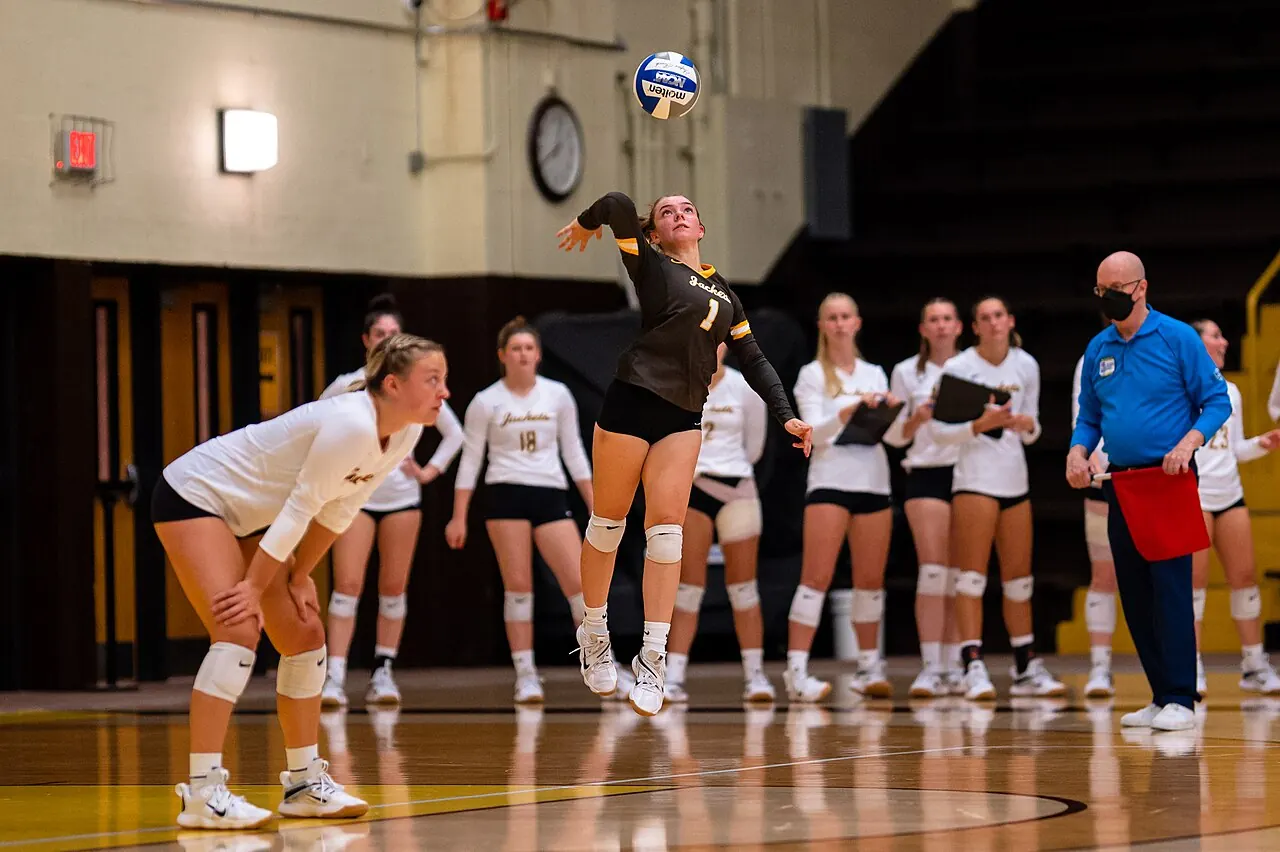
Image source and license
- Original photograph
- Baldwin Wallace Yellow Jackets Volleyball (51443800579).jpg
- Source address
- https://commons.wikimedia.org/wiki/File:Baldwin_Wallace_Yellow_Jackets_Volleyball_(51443800579).jpg
- License address
- https://creativecommons.org/licenses/by/2.0
- Preparation
- Full frame retained; resized and converted to WebP for the web. Image remains available under its source license.
In this guide
Start with the court diagram
The diagram shows one illustrative defensive arrangement with the setter in the back row, three front-row attackers and a libero replacing the other middle in the backcourt. It is not a serve-receive legality diagram or a lineup sheet.
From this viewpoint, the net is at the top and the endline is at the bottom. Left and right describe this team's view while facing the net. The numbered zones help you orient yourself, while the role labels describe one possible arrangement after players move into their playing locations.
Teams shift those locations according to the serve, opponent, system and rally. Use the picture as an introduction, then watch the actual team's movement rather than expecting players to remain inside imaginary boxes.
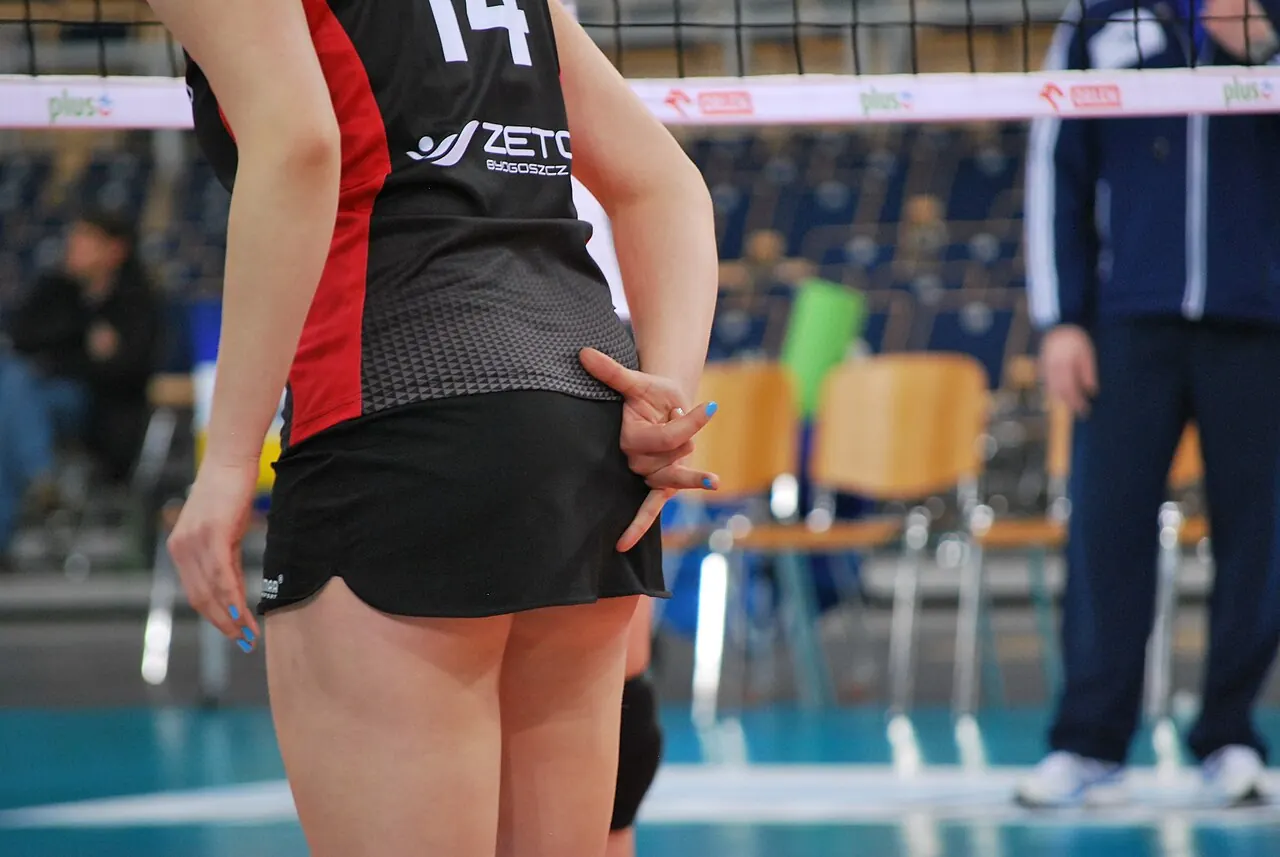
Image source and license
- Original photograph
- Signs of the setter 01.jpg
- Source address
- https://commons.wikimedia.org/wiki/File:Signs_of_the_setter_01.jpg
- License address
- https://creativecommons.org/licenses/by-sa/3.0
- Preparation
- Full frame retained; resized and converted to WebP for the web. Image remains available under its source license.
Setter: make the next attack possible
The setter usually organizes the second contact and chooses how to distribute the ball. A good set is not simply a high ball near the net; it needs to suit the attacker, the pass and the opposing defense.
Watch where the setter has to take the ball. A controlled pass can leave several options available. A difficult first contact can force the setter to chase and simplify the attack. That context matters when you judge the decision.
The setter also defends, serves and may attack when the rules and situation allow. The role does not disappear when another teammate takes the second ball. USA Volleyball's setter guidance emphasizes both accurate delivery and decision-making. [2]
Outside hitter: handle a broad workload
Outside hitters commonly attack from the left pin and can also carry significant serve-reception and back-row responsibilities. Their workload can include difficult balls when a pass pulls the offense away from its preferred timing. [3]
That is why raw kill totals need context. An outside taking a high volume of challenging swings is not necessarily doing the same job as an attacker receiving fewer, cleaner opportunities.
When watching, notice what happens before the approach. Did the player just pass? Is the set arriving from a difficult angle? Is the opponent already forming a double block? Those details help explain the quality of a swing more fairly than the outcome alone.
Opposite: balance the attack and block
The opposite commonly attacks from the right side and can carry an important blocking assignment against the opponent's left-side attack. The exact responsibilities vary with the team's system and personnel. [3]
Do not assume that the opposite is simply another outside hitter standing elsewhere. Serve-reception responsibilities, front-row availability and back-row usage can differ. Watch how the team organizes the role rather than importing one lineup's pattern into every match.
For a fan, a useful starting question is whether the setter has a right-side option when the left-side attack is under pressure. A balanced distribution can make the opposing block cover more space and more possibilities.
Middle blocker: read, move and threaten quickly
The middle's work centers on blocking along the net and providing a fast attacking option through the middle area. Timing with the setter is especially visible when the first pass allows a quick offense. [4]
Follow the middle even when the ball goes elsewhere. A credible attacking threat can influence the opposing blocker without receiving the set. On defense, the middle may need to move rapidly to help close a block at either pin.
That makes the position difficult to evaluate through kills alone. Ask whether the player arrived in time, helped organize the block and remained a useful option when the pass permitted it. A quiet attacking line does not describe every contribution.
Libero: protect the first contact
The libero is the player in the contrasting jersey, specializing in back-row work. Serve reception, digging and keeping a playable next contact available are central parts of the role. NCAA rules give the libero specific restrictions and replacement procedures. [5]
Watch the quality of the ball sent toward the setter rather than only the dramatic dive. A player who reads the attack early can make a valuable defensive contact look simple.
The libero often works in the back-row portion of a middle's rotation, but the actual lineup should be checked. Our libero guide explains the different jersey, serving in college play and the restrictions that matter when unusual contacts draw a whistle.
Defensive specialist: a different route to backcourt help
A defensive specialist can enter through ordinary substitution procedures to help with passing, serving or defense. Unlike the libero, the player does not gain the libero's separate replacement mechanism simply by taking a defensive assignment.
For fans, follow whom the specialist replaces and what the team is trying to improve. The change might target a particular serving rotation or backcourt responsibility, rather than signal a problem with every part of the substituted player's game.
Do not invent the coach's reason if it has not been explained. Describe the visible pattern first: which player enters, when it happens and what responsibilities follow. That is enough to understand the structure without claiming private tactical information.
Serving specialist: a focused contribution
A team may use a player mainly for a serving assignment. The immediate objective can involve creating pressure, targeting a receiving area or improving the team's chances during a particular turn in the service order.
One serve does not capture the entire strategy. An aggressive approach can create an error as well as pressure, and a serve that produces no ace can still make the opponent's first attack harder to organize.
When judging the contribution, watch the opponent's pass and the next attacking options. Avoid counting only direct aces or assuming every missed serve proves the substitution was pointless. The useful analysis considers what the team was trying to accomplish over the sequence.
What 5–1 and 6–2 mean
These labels describe offensive systems rather than the number of players allowed on court. A 5–1 commonly uses one setter running the offense through the rotation. A 6–2 commonly uses two setters who set from the back row, with the lineup arranged to preserve front-row attacking options. [1]
For a viewer, identify who takes the second contact and whether that player's front-row status changes the available options. You do not need to memorize every rotation immediately.
Start with one cycle through the lineup. Notice when the setter moves into the front row, whether another setter enters and how the team's attacking choices change. The pattern becomes easier to recognize after watching several rallies in sequence.
Rotation and role should not be confused
A roster can call someone an outside hitter while the player is temporarily in the back row. That is not a contradiction. The job title and the player's current rotational status describe different things.
Likewise, players moving after the serve are not abandoning their responsibilities. They are organizing into useful attacking and defensive locations within the rules. A still photograph taken during a rally does not reveal the entire starting formation.
If you want to understand a rotation, watch from before service contact through the first attack. Pausing only at the final swing can hide the movement that made the play possible.
Follow one rally from start to finish
Imagine a hypothetical clean sequence. The libero controls the serve, the setter reaches the ball comfortably, the middle presents a quick option and the setter sends the ball outside. The outside attacks while teammates prepare to cover a possible block.
The attacker gets the visible finish, but several roles made the opportunity possible. Change the first pass and the setter's options may shrink. Change the middle's timing and the opposing block may organize differently.
On the other side, watch the relationship between the front-row block and backcourt defenders. A defensive plan connects those jobs. A ball landing in one area should not automatically be blamed on the nearest player without considering the arrangement.
Learn one role at a time
You do not need to identify every assignment in your first match. Follow the setter for a few rallies, then the libero, then a middle blocker. That focused approach makes the movement easier to recognize. Return to the diagram between sets, using it to orient yourself rather than as a fixed map of every play.
Use the box score as a companion, not the whole explanation
Kills, assists, blocks and digs can help identify who carried different workloads. They do not fully describe passing quality, blocker movement, coverage or the difficulty of each contact.
Compare statistics with role and opportunity. A setter's assist total depends partly on attackers finishing. A defender's dig opportunities depend on where the opponent sends the ball. A middle can influence a rally without receiving a set.
Our box-score guide provides the next step. For now, learn to recognize the jobs and follow one player through several rallies. Once the roles are familiar, the match becomes a connected sequence of decisions rather than six players chasing the same ball.
Sources
- USA Volleyball: Rotation, playing positions and offensive systemshttps://usavolleyball.org/play/rules-of-volleyball/
- USA Volleyball: Thoughts for settershttps://usavolleyball.org/resource/thoughts-for-setters/
- Volleyball World: Player positions and roleshttps://en.volleyballworld.com/blogs/what-are-the-positions-and-roles-in-volleyball-x5886
- USA Volleyball: Beginner's guide and position descriptionshttps://usavolleyball.org/wp-content/uploads/2022/03/Volleyball-Beginners-Guide-by-SportsEngine.pdf
- NCAA: The college volleyball libero, explainedhttps://www.ncaa.com/news/volleyball-women/article/2024-12-21/college-volleyball-libero-explained