Volleyball Basics
Why Does One Volleyball Player Wear a Different Jersey?
Sources reviewed ; current research and later results are reflected in this review.
The volleyball player wearing a different-colored jersey is the libero, a specialist back-row player. The contrasting uniform helps officials and spectators identify a role with different playing restrictions. It is not a sign that the player belongs to the other team, has been penalized or is automatically the captain.
For a new fan, the libero can be the easiest player to recognize and one of the hardest to understand. She appears frequently, makes important defensive contacts and sometimes leaves without the formal-looking substitution you expected.
This guide explains the role in NCAA women's indoor volleyball, with the current college rule set kept separate from international or school rules. Once you know what to watch, the different jersey becomes a useful guide to how the team handles the first contact and organizes its defense.
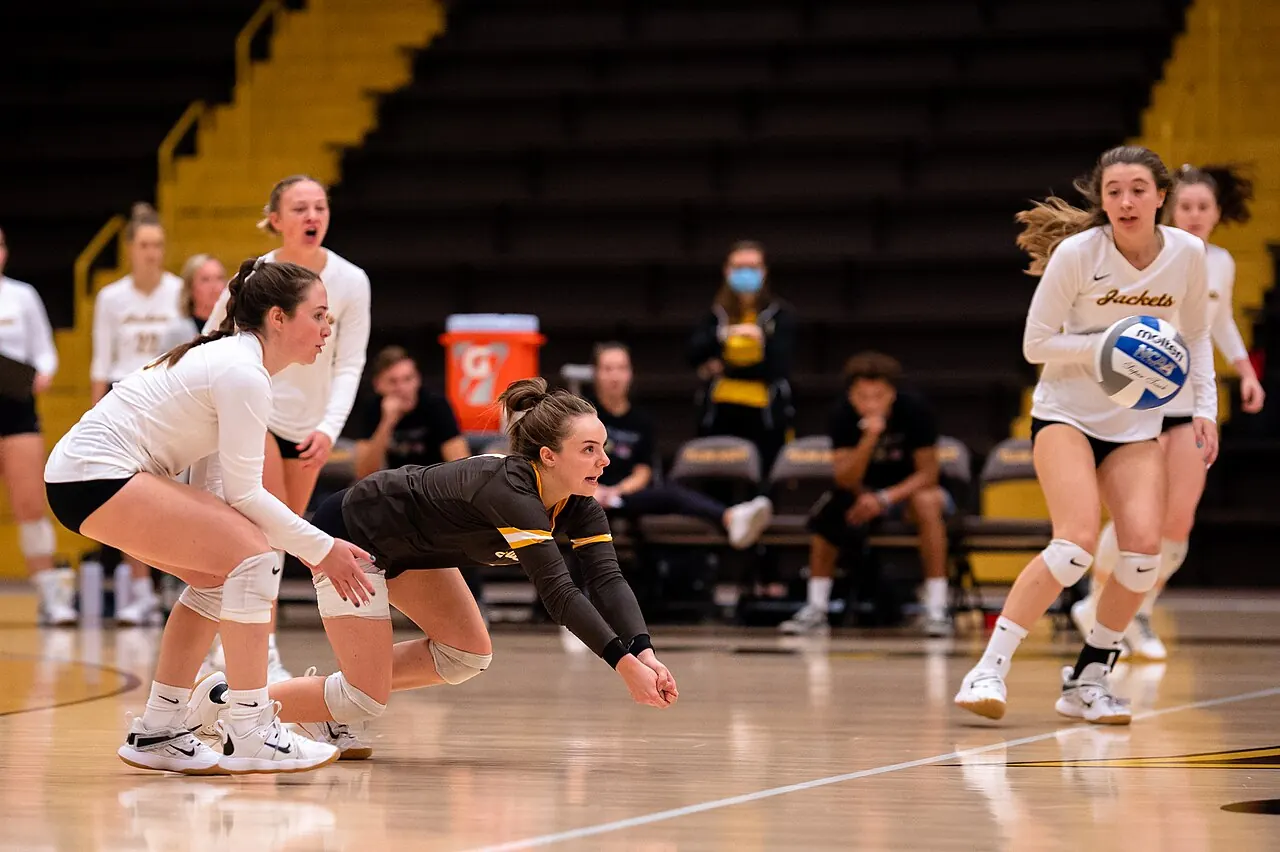
Image source and license
- Original photograph
- Baldwin Wallace Yellow Jackets Volleyball (51601531132).jpg
- Source address
- https://commons.wikimedia.org/wiki/File:Baldwin_Wallace_Yellow_Jackets_Volleyball_(51601531132).jpg
- License address
- https://creativecommons.org/licenses/by/2.0
- Preparation
- Full frame retained; resized and converted to WebP for the web. Image remains available under its source license.
In this guide
Why the jersey needs to stand out
The NCAA rule book requires the libero jersey to contrast clearly with the predominant colors worn by teammates. The purpose is identification: officials need to recognize the player whose role carries special restrictions. [1]
The color itself does not communicate a universal position ranking or team hierarchy. One program's libero may wear white while teammates wear a dark color; another program can use a different contrast. Look for the relationship within that team's uniforms rather than expecting every libero in the country to dress alike.
For spectators, the contrast is helpful too. It gives you a consistent player to follow when the ball moves quickly. Start by watching where that player stands before serve and how she moves after the first contact.
What the libero actually contributes
The libero's most visible jobs are passing serves and defending attacks. The objective is not merely to touch the ball, but to keep the team able to run a useful next play. A controlled contact can give the setter choices; a desperate save can at least keep the rally alive.
That makes the role easier to appreciate when you watch the quality of the next contact. Did the setter reach the ball comfortably? Could the team use several attackers? Did the defense turn a difficult attack into a playable transition?
Those questions reveal more than simply counting spectacular dives. A defender who reads the play early may make an important ball look ordinary. Good positioning can remove the need for a dramatic recovery.
Serve reception and digging are related, but different
Serve reception begins with the opponent's serve. A dig responds to an opponent's attack. Both require control, but the flight, speed and decision-making context can differ.
Watch a libero preparing for serve reception. She may communicate about seams, adjust her starting depth and coordinate with other passers. After the rally develops, her defensive location depends on the block and the attacking situation.
Do not assume a player had an easy night because she recorded few digs. The opponent may have served elsewhere or attacked into another area. To evaluate a performance fairly, look at the opportunities and responsibilities, not only the largest visible statistic.
Why the libero often replaces a middle blocker
Many lineups use the libero in the back-row portion of a middle blocker's rotation. That lets the team emphasize the middle's work at the net while using a specialist for backcourt responsibilities. It is a common arrangement, not a requirement that every team use an identical pattern.
For a fan, follow one pair of players through several rotations. Notice when the front-row player moves toward the back row and the libero enters, then when the original player returns for net duties.
That exchange can make the lineup look confusing if you expect six players to remain in fixed jobs all match. The team is coordinating the rotation order with specialized roles, rather than abandoning the rotation whenever the jersey changes.
Replacements are not ordinary substitutions
Libero replacements follow their own procedure and are treated separately from ordinary substitutions. That is why the libero can enter and leave in a pattern that looks different from a coach sending a substitute through the formal substitution process. The NCAA's libero explainer describes the distinction for viewers. [2]
Do not interpret frequent appearances as evidence that the coach is ignoring the substitution limit. The role has a specific mechanism built into the rules.
You do not need to master every exceptional case to follow a match. Start by identifying whom the libero replaces and where the team is in its rotation. If an unusual exchange produces a whistle, consult the current rule interpretation rather than assuming every replacement works without conditions.
Can the libero serve in college volleyball?
In NCAA women's volleyball, the libero may serve in one position in the service order. When two liberos are designated, their serving remains limited to that same service-order position for the set. This is a useful place to avoid importing a different competition's rule. [1]
If you have watched international volleyball, you may have learned a different answer about libero serving. The sport has several rule codes, so “I have never seen that allowed” is not enough to decide a college call.
When watching, note the service-order slot rather than assuming the libero can serve for any teammate at any time. The jersey identifies a specialized role, not unrestricted permission to move through the lineup.
What the libero cannot do
The libero is restricted to back-row play, cannot block or attempt to block, and cannot complete an attack with the ball entirely above the top of the net. If the libero makes an overhead finger pass from the front zone, a teammate may not complete an attack on that ball while it is entirely above the top of the net. [1]
For a new viewer, do not reduce this to “the libero can never send the ball over.” That shortcut misses the conditions that make a particular contact legal or illegal.
Instead, watch the contact height, location and sequence when a call occurs. A slow replay may reveal a detail that was impossible to see live. Keep your explanation proportional to what the camera actually shows.
Why an emergency set can look unusual
When the setter makes the first defensive contact, another player has to organize the next ball. The libero may become involved in that emergency sequence, and her choices must account for the role's restrictions.
This can explain why a player uses a forearm pass where a new fan expected an ordinary overhead set. The choice may be tactical, technical or connected to the location and rules of the play.
Do not assume every unusual contact is a mistake. Watch what happened immediately before it. A teammate may have been pulled out of position, forcing a practical recovery rather than the offense's preferred pattern.
Can a team use two liberos?
Current NCAA women's rules allow a team to designate two liberos, with only one on court at a time. The presence of another contrasting jersey on the bench does not mean the team is about to play both together. [3]
For a spectator, check the lineup information or broadcast explanation if the identity changes. A different libero can appear without the team changing the basic purpose of the role.
Avoid turning the number of designated liberos into a judgment about quality. The reasons for a team's choices can include personnel and match responsibilities. Unless the coach has explained the decision, describe what you observe rather than inventing an injury or disciplinary story.
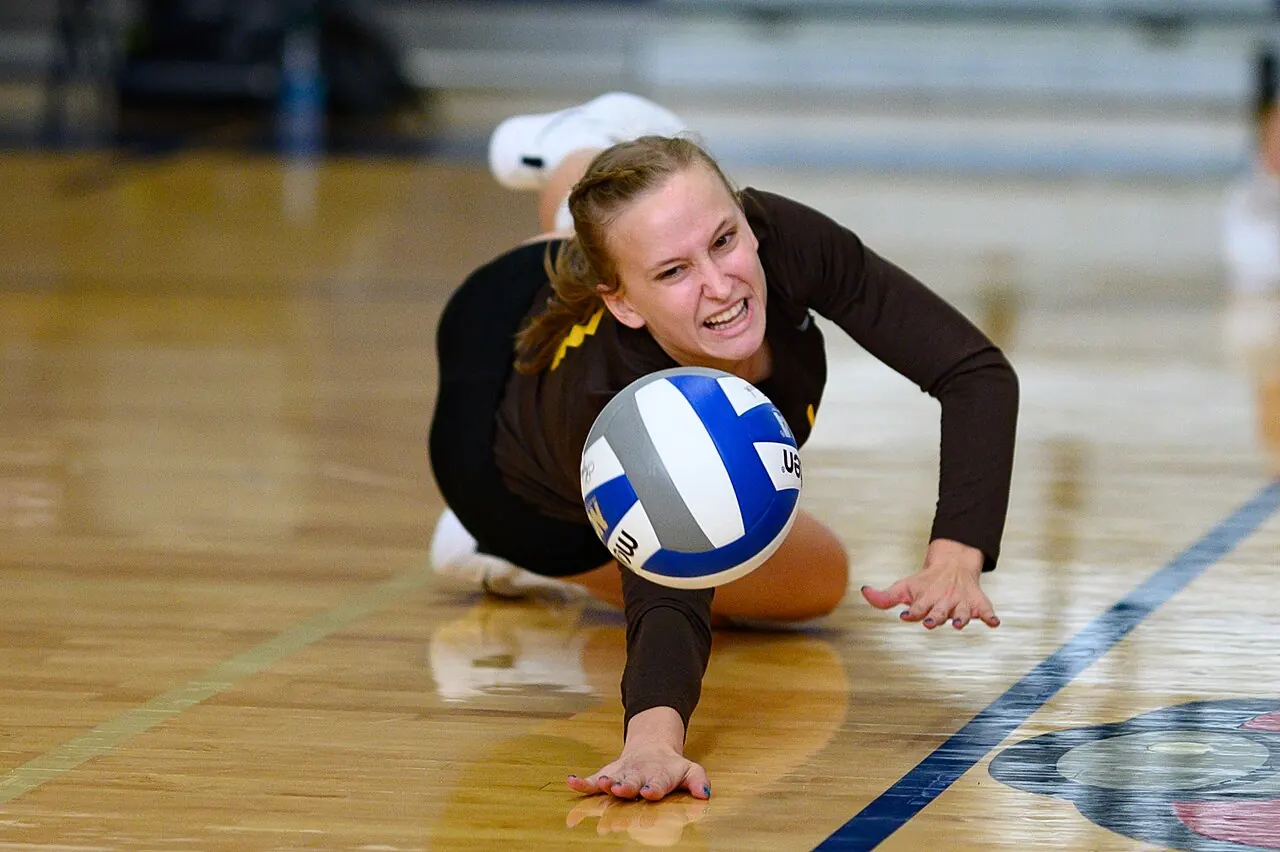
Image source and license
- Original photograph
- Baldwin Wallace Yellow Jackets Volleyball (48781697883).jpg
- Source address
- https://commons.wikimedia.org/wiki/File:Baldwin_Wallace_Yellow_Jackets_Volleyball_(48781697883).jpg
- License address
- https://creativecommons.org/licenses/by/2.0
- Preparation
- Full frame retained; resized and converted to WebP for the web. Image remains available under its source license.
How to watch the libero for one whole rally
Start before the serve. Identify her area of responsibility and the nearby passers. When the ball crosses, watch her first movement rather than following only the ball.
If she makes the first contact, track where it sends the setter. If another teammate passes, watch how the libero prepares to cover an attack or move into defense. The work continues even when she is not the player touching the ball.
After the opponent attacks, look at the relationship with the block. A defender is reading both the attacker and the space the block is attempting to take away. A ball landing nearby does not automatically mean that the nearest player alone caused the breakdown.
Which statistics help?
Digs can show part of the defensive workload, but they do not capture every good positioning decision or controlled serve reception. Reception information, errors and the match context can add useful detail when available.
Compare like with like. A five-set match offers more opportunities than a quick sweep, and opponents distribute their attacks differently. Per-set figures can help, but they still need the surrounding role and opportunity context.
Our box-score guide explains how to read the main columns without treating one number as a complete player evaluation. A full replay remains valuable when you want to understand the quality and difficulty of individual contacts.
The role is easier to value once you stop chasing highlights
The libero often helps the team before the memorable swing. A useful first contact keeps options open. A controlled defensive ball gives the offense another chance. Clear communication can prevent two teammates from chasing the same seam.
On your next match, spend several rallies following the contrasting jersey instead of only the attacker. Notice the preparation, the first step and what the next player can do after the contact.
The jersey answers the original question immediately: that player is the libero. Watching the work behind it explains why the role matters to the entire team, even when the final point belongs to someone else in the box score.
Sources
- NCAA: 2026–27 women's volleyball rules, libero uniforms and restrictionshttps://ncaaorg.s3.amazonaws.com/championships/sports/volleyball/rules/women/PRWVB_RulesBook.pdf
- NCAA: The college volleyball libero, explainedhttps://www.ncaa.com/news/volleyball-women/article/2024-12-21/college-volleyball-libero-explained
- NCAA: Approval of two-libero designationhttps://www.ncaa.org/story.aspx?file_date=2%2F20%2F2024&filename=media-center-double-contacts-approved-in-womens-volleyball