
Volleyball Basics
How Long Is a College Volleyball Match? A Fan’s Planning Guide
Sources reviewed ; current research and later results are reflected in this review.
A college volleyball match often fits into roughly 90 minutes to two and a half hours, but there is no fixed game clock. A quick sweep can finish sooner, and a long five-set match can run beyond that window. For planning, leave flexibility rather than treating a television slot as a guaranteed finish time.
The ranges below are editorial planning allowances, not measured national averages or NCAA time limits. Actual duration depends on the number of sets, the closeness of the scoring, stoppages and the event's operating schedule.
If you are watching at home, leave recording room. If you are attending, add arrival and exit time separately. The match itself is only one part of the evening, especially when parking, security and a crowd leaving together are involved.
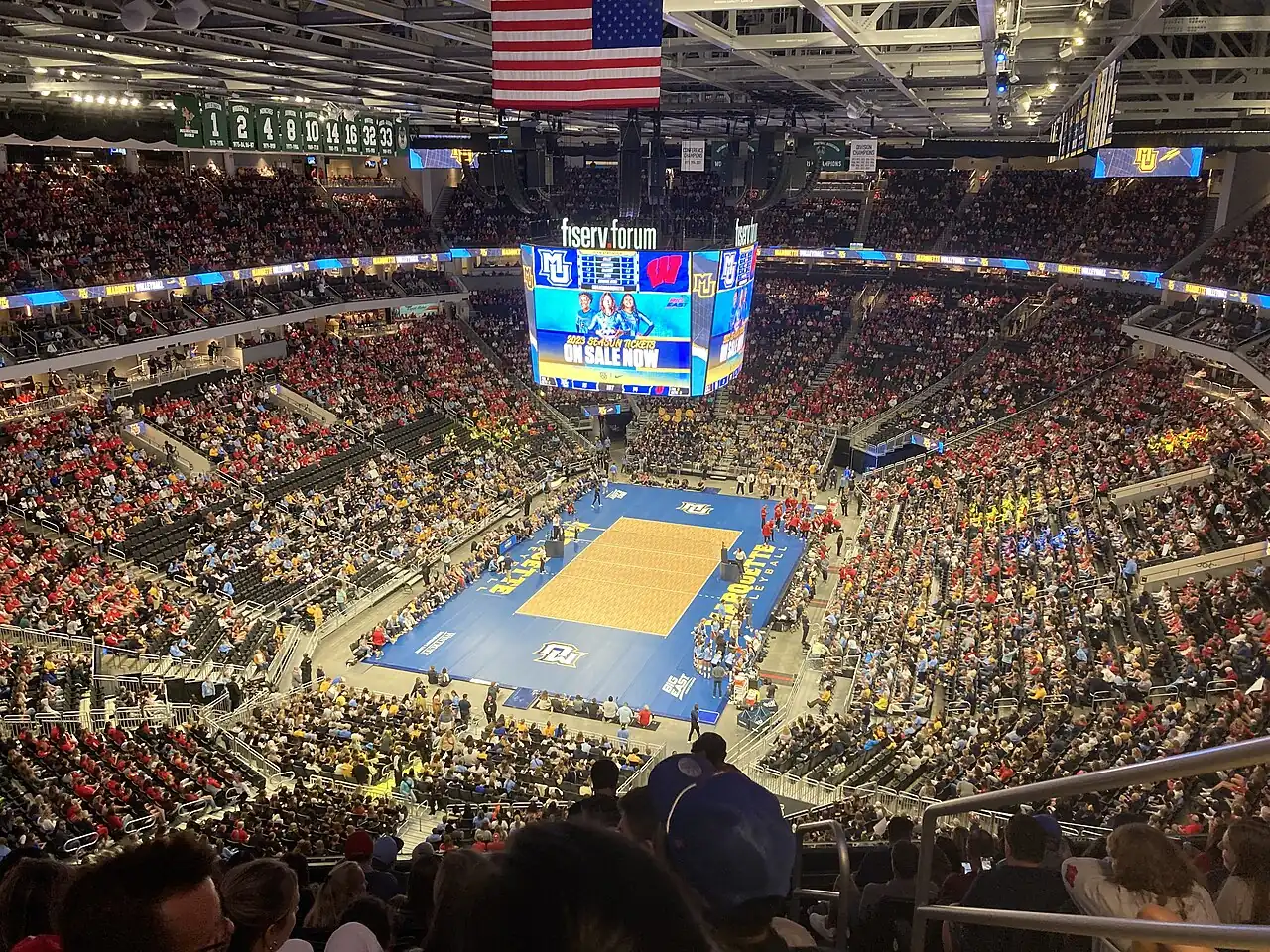
Image source and license
- Original photograph
- Wisconsin vs. Marquette women's volleyball 2023 06 (timeout).jpg
- Source address
- https://commons.wikimedia.org/wiki/File:Wisconsin_vs._Marquette_women%27s_volleyball_2023_06_(timeout).jpg
- License address
- https://creativecommons.org/licenses/by-sa/4.0
- Preparation
- Full frame retained; resized and converted to WebP for the web. Image remains available under its source license.
In this guide
A useful planning table
| Match outcome | Rough match-only allowance | How to use it |
|---|---|---|
| Three-set sweep | About 60–90 minutes, sometimes longer | A shorter possibility, not a promised early finish |
| Four sets | About 90–120 minutes, with variation | A reasonable middle planning range |
| Five sets | About two to two and a half hours or more | Leave the largest buffer for a close contest |
| Multi-match session | Longer than one team's match alone | Check when your match follows another contest |
Do not use the low end to book a tight departure. The table helps compare scenarios, not predict a specific match minute by minute. A competitive sweep can take longer than a one-sided scoreline in another fixture.
Why volleyball has no predictable final whistle
The format is driven by sets and points rather than a running game clock. In NCAA women's indoor volleyball, a team normally needs three set wins to take the match. Standard sets target 25 points and a deciding fifth targets 15, with a two-point winning margin and no point cap. [1]
That structure means the same number of sets can contain different amounts of play. Several short rallies and a decisive score can move quickly. Extended rallies, close scoring and repeated ties near the target can keep the set going.
The useful planning question is therefore not “How many minutes are left?” It is “How many sets and points remain, and how uncertain is the path from here?” A scoreboard gives you progress through the format without giving a reliable countdown.
A sweep is not always a short match
A 3–0 result tells you the winner took three sets without losing one. It does not tell you whether the sets were comfortable or repeatedly extended beyond the usual target.
Compare two hypothetical sweeps. One finishes with broad margins and few interruptions. Another includes several long rallies and two extended sets. Both produce the same match score, but a fan planning a journey home could experience very different evenings.
Do not treat a favorite's expected win as a transport guarantee. Even if the prediction is correct, the path to it can still take longer than you allowed. Book around a flexible window rather than assuming the simplest version of the result.
Four sets add more than a line on the scoreboard
A fourth set creates another full contest within the match, along with the associated break and preparation. It can also change the atmosphere if a team that looked close to defeat suddenly extends the evening.
For planning, a 2–1 lead is a useful reminder that the finish remains uncertain. The next set could end the match or send it to a deciding fifth. Neither outcome can be converted into a dependable departure time from the score alone.
If you are watching while preparing for another commitment, make that uncertainty explicit. A plan that requires leaving at the exact end of the fourth set depends on a result that has not happened yet.
The fifth set is shorter in target, not necessarily in tension
A deciding set has a lower point target, but it still requires a sufficient winning margin. A close finish can continue beyond the target, and every extended rally can feel especially consequential.
Do not assume that reaching the fifth means “only a few minutes left.” There is still a complete deciding contest to play, plus the preparation between sets. If the score stays close, the end remains open.
Our sets and scoring guide walks through examples. For a practical evening plan, the main lesson is to protect a buffer once the match reaches this stage rather than promising an immediate finish.
Timeouts, reviews and other pauses matter
The on-court rallies are only part of the elapsed time. Team timeouts, substitutions, video reviews, floor attention and other stoppages can add pauses. Their impact varies from match to match.
The NCAA's 2026 Division I changes also describe an alternative technical-timeout protocol, including a break when a team reaches 15 in nondeciding sets when that protocol is used. Do not assume every broadcast follows an identical pattern. [2]
For fans, the key is to leave room for interruptions without trying to predict every one. A close call can take time to resolve. Treat the pause as part of the event rather than evidence that the published first-serve time promised a shorter evening.
First serve and arrival time are different appointments
If you want to be seated for introductions or warmups, arrive before the listed match start. How much earlier depends on parking, ticket collection, security, concessions and how familiar you are with the venue.
For an unfamiliar building, a margin of 30–60 minutes before the scheduled start is a practical starting recommendation to adjust. It is not a universal venue rule. Read the school's actual door and entry information for the event.
Keep the arrival plan separate from the match-duration estimate. Saying “the match might last two hours” does not include the time you spend finding a lot, walking to the entrance or waiting for your group to enter together.
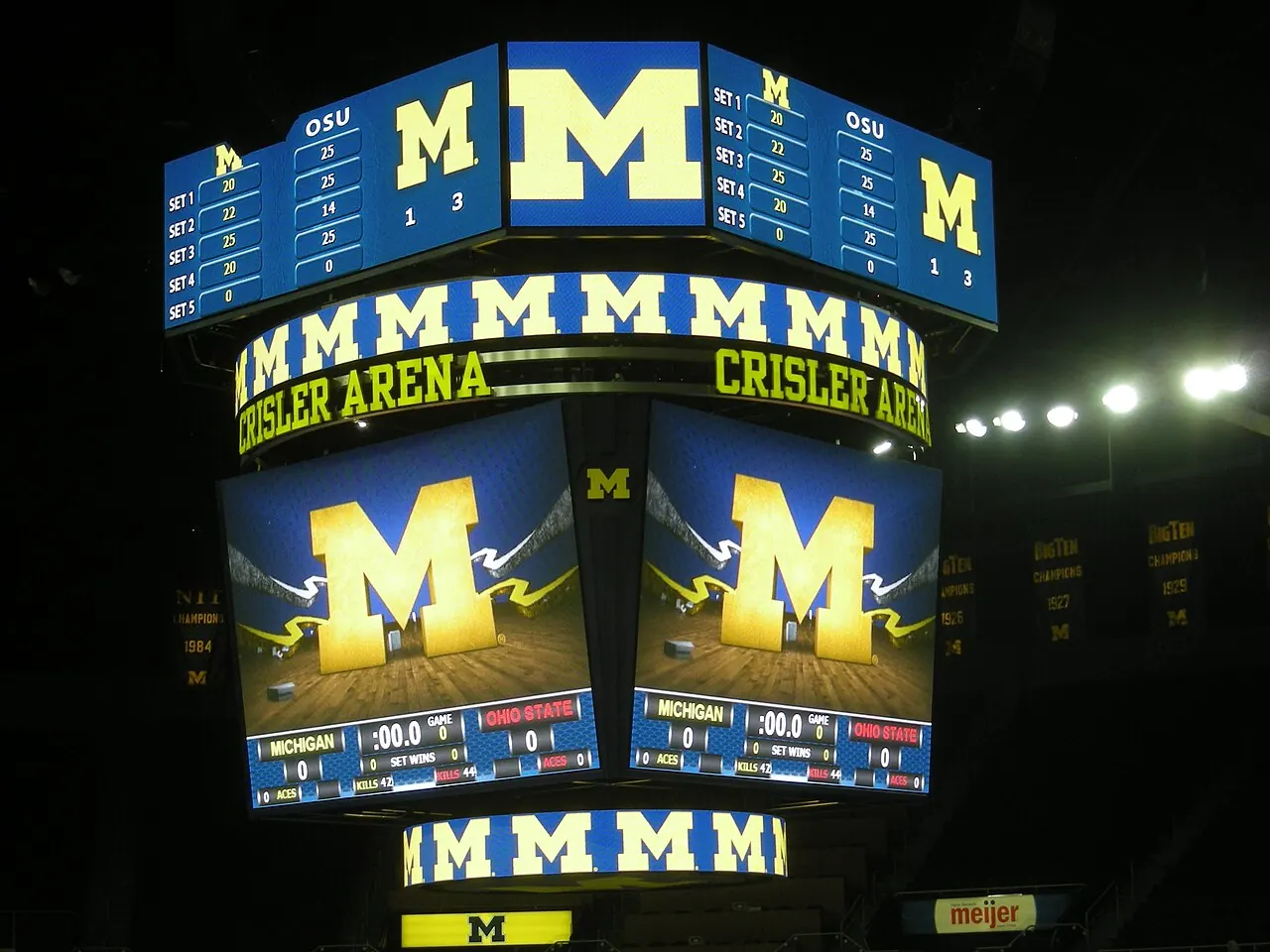
Image source and license
- Original photograph
- Ohio State vs. Michigan volleyball 2011 16.jpg
- Source address
- https://commons.wikimedia.org/wiki/File:Ohio_State_vs._Michigan_volleyball_2011_16.jpg
- License address
- https://creativecommons.org/licenses/by-sa/4.0
- Preparation
- Full frame retained; resized and converted to WebP for the web. Image remains available under its source license.
A later match can inherit an earlier delay
At a tournament or doubleheader, your team's advertised start can be connected to an earlier match. If that contest runs long, the next one may not begin at the time you first expected.
Check whether the schedule uses a fixed time, an approximate time or wording indicating that the match follows another event. The host's current information is more useful than a calendar entry copied several weeks earlier.
For spectators attending both matches, that can be part of the appeal. For someone arriving only for the second, it is a reason to stay flexible. Keep the official live-statistics or event page available so you can check progress before leaving.
Planning a family visit
A family outing has needs beyond the final score. Consider meals, noise, breaks and the trip home when deciding how long the evening is likely to feel. A child who enjoys the opening set may still need a pause during a long match.
Check the venue's rules on bags, food and re-entry before packing. Do not assume you can leave the building and return, or bring the same supplies allowed at another school's gym.
Choose a plan that can tolerate a longer match. That might mean an earlier meal, a flexible ride home or accepting that one person may leave before the final rally. Making that decision beforehand reduces stress during a close finish.
Recording and replay planning at home
If your television service supports recordings, check whether you can extend the end time. A fixed program window may not cover an unusually long match, particularly when the event follows another broadcast.
If you intend to watch a replay, confirm the full-match archive and its access requirements. A short highlight package is a different product and may omit the sequence that interested you.
Avoid spoilers by saving the event page and disabling score alerts. Our viewing guide can help identify the correct service, while the team schedules help you keep the next first serve in view.
Leaving after the match takes time too
The final rally is not the moment your car reaches the main road. Add the walk out, meeting your group, collecting belongings and leaving the parking area. A close, well-attended match can produce a crowded exit.
If you use rideshare or public transport, plan the departure location and available service rather than assuming an instant pickup. For a late match, check the operating hours relevant to your actual route.
This matters most when you have another fixed commitment. A generous match estimate can still fail if you leave no exit margin. Treat the whole trip as the appointment, not only the period between the first serve and match point.
Put the buffer where it matters
A flexible restaurant booking may absorb a delay more easily than the last departure of the night. Identify the least flexible part of your plan first, then work backward. If there is no reasonable margin around that commitment, choose another arrangement before buying tickets rather than relying on a short match.
The best planning answer
Allow a flexible match window, with more room for four or five sets, then add your own arrival and departure needs. Use the rough ranges as scenarios rather than promises.
Check the current fixture, venue instructions and any earlier session before making the final plan. If a tight connection only works with a quick sweep and an empty parking lot, the plan needs more room.
Volleyball's uncertain finish is part of what makes it compelling. A practical buffer lets you enjoy that uncertainty instead of spending a deciding set calculating whether you can still make the train.
Sources
- NCAA: 2026–27 women's volleyball rules, scoring and match durationhttps://ncaaorg.s3.amazonaws.com/championships/sports/volleyball/rules/women/PRWVB_RulesBook.pdf
- NCAA: 2026–27 Division I rules changes and timeout protocolhttps://ncaaorg.s3.amazonaws.com/championships/sports/volleyball/rules/women/2026-27PRWVB_D1RulesChanges.pdf