
Volleyball Basics
How Many Sets Are Played in College Volleyball?
Sources reviewed ; current research and later results are reflected in this review.
College women's indoor volleyball normally uses a best-of-five format. The first team to win three sets wins the match, so a completed match usually lasts three, four or five sets. The first four sets target 25 points; a deciding fifth targets 15. Every set requires a two-point winning margin, with no point cap. [1]
That is the quick answer. The confusing part for a new fan is that the scoreboard contains two different contests at once: points within the current set and sets within the match.
Once you separate those layers, a score such as 2–1 or 24–24 becomes much easier to read. This guide uses simple hypothetical examples to explain what can happen next and why winning more total points does not necessarily mean winning the match.

Image source and license
- Original photograph
- Ohio State vs. Michigan volleyball 2011 16.jpg
- Source address
- https://commons.wikimedia.org/wiki/File:Ohio_State_vs._Michigan_volleyball_2011_16.jpg
- License address
- https://creativecommons.org/licenses/by-sa/4.0
- Preparation
- Full frame retained; resized and converted to WebP for the web. Image remains available under its source license.
In this guide
Points win sets; sets win matches
Think of each set as a separate race. The points from one set do not carry forward into the next. What carries forward is the set result: one team moves one step closer to the three set wins needed for the match.
Suppose Team A wins the opening set 25–18. Team A leads the match 1–0, but the second set starts at 0–0. The seven-point margin from the first set does not become a head start.
That reset gives a struggling team a fresh scoring contest without erasing the significance of the set it lost. It also explains why a team can recover from a difficult opening and still win the match.
The three normal match results
| Result | Meaning | Number of sets played |
|---|---|---|
| 3–0 | The winner took the first three sets | Three |
| 3–1 | The winner took three sets and lost one | Four |
| 3–2 | Both teams won two before the deciding set | Five |
The winning team always finishes with three set wins in the standard completed format. A score written 0–3 or 1–3 usually reflects the result from the losing team's perspective rather than a different match format.
When you read a school schedule, check whose perspective the score uses. A result marked “L 2–3” means that school lost a five-set match after winning two sets. It does not mean it lost the fifth set by a single point.
What a sweep means
A sweep is a 3–0 match win. One team won three sets before the other won any. That description tells you the distribution of sets, rather than how easy the individual contests were.
For example, a hypothetical sweep of 25–23, 28–26 and 25–22 contains close scoring throughout. It shares the same 3–0 match label as a sweep with much wider margins.
That is why a result alone can hide the match's texture. If you want to know whether a team was pushed, read the set scores or watch the replay. The match score gives the outcome in a compact form, not a complete account of the competition.
A four-set match can unfold in several orders
A 3–1 result does not tell you which set the winner lost. The winning team might drop the opener and take the next three, or build a 2–0 lead, lose the third and finish in the fourth.
Those sequences can feel different to watch, even though the final label is the same. One tells a recovery story; the other involves a team stopping an opponent's attempt to extend the match.
When reading a recap, keep the order in view. “Won in four” is a useful summary, but the progression helps explain the adjustments, pressure and momentum the writer describes.
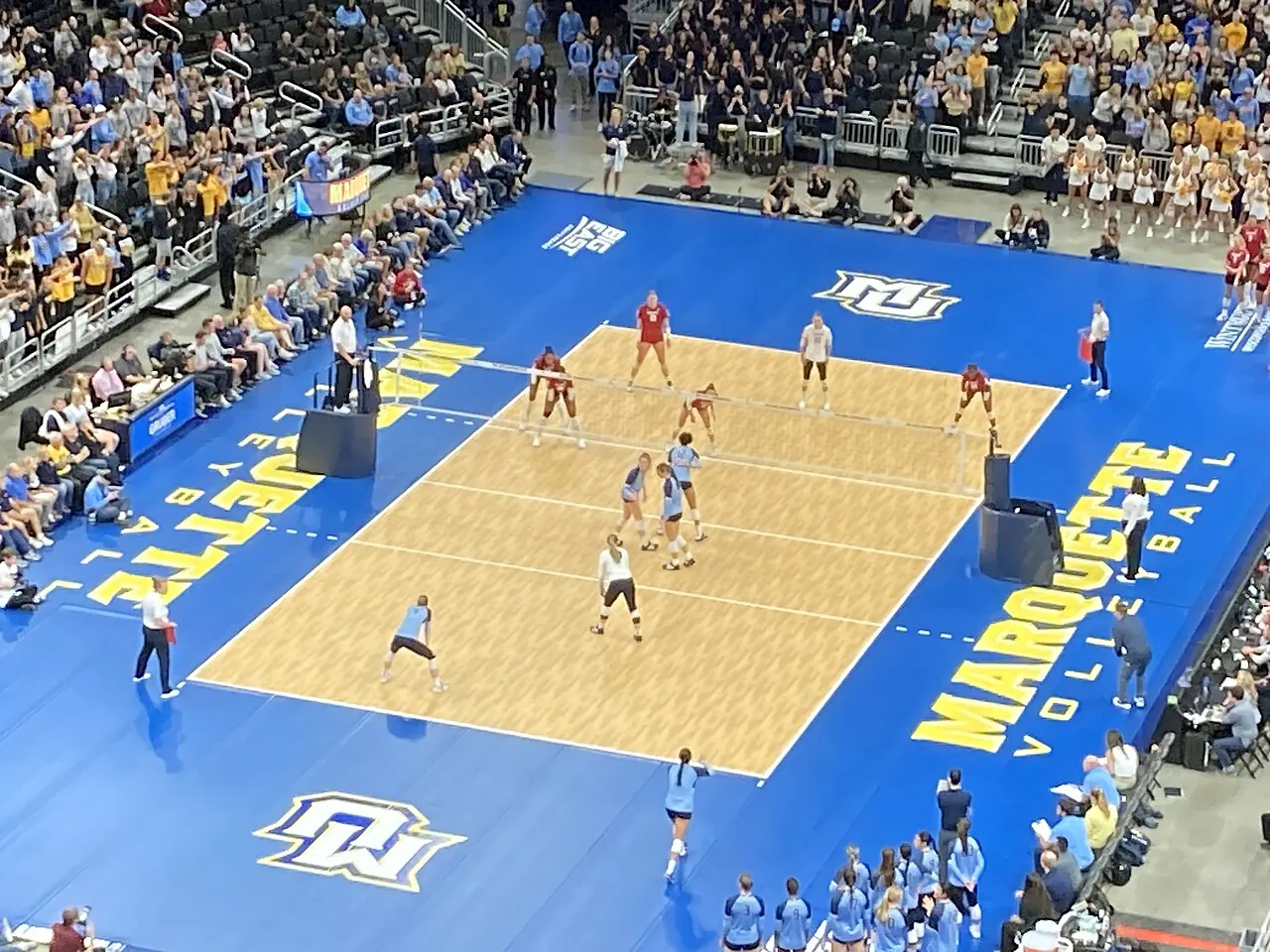
Image source and license
- Original photograph
- Wisconsin vs. Marquette women's volleyball 2023 08 (in-match action).jpg
- Source address
- https://commons.wikimedia.org/wiki/File:Wisconsin_vs._Marquette_women%27s_volleyball_2023_08_(in-match_action).jpg
- License address
- https://creativecommons.org/licenses/by-sa/4.0
- Preparation
- Full frame retained; resized and converted to WebP for the web. Image remains available under its source license.
When the match reaches a fifth set
The fifth is played only when the first four leave the teams tied at two sets each. It is the deciding set because its winner also reaches three set wins for the match.
A lower point target changes the amount of scoring needed, but it does not remove the winning-margin requirement. If the deciding set reaches 14–14, another point alone cannot finish it because that produces only a one-point lead.
A hypothetical sequence of 15–14, 15–15 and 16–15 still leaves the set alive. A 17–15 finish would settle it. The target tells you when winning becomes possible; the margin determines whether the score is actually sufficient.
Win by two, explained slowly
Take a standard set at 24–24. If Team A wins the next rally, it leads 25–24. That is beyond the ordinary target but only a one-point advantage, so play continues.
If Team A wins again, 26–24 gives it the needed margin. If Team B instead ties the set 25–25, the race continues. A later finish such as 28–26 is perfectly consistent with the same scoring principle.
There is no need to memorize every possible extended score. Ask two questions: has a team reached the target, and does it lead by at least two? If either answer is no, the set is not over under the normal scoring rule.
Set point and match point are different
“Set point” means the next rally could finish the set for the team holding that opportunity. “Match point” means the next rally could finish the entire match because that team is also one set win from victory.
At a hypothetical 24–20 with a 1–0 match lead, Team A has set point but cannot end the whole match on that rally. At the same point score with a 2–0 match lead, it also has match point.
The distinction becomes particularly useful in a deciding set. The opportunity to finish that set is also the opportunity to finish the match. A team can save several such opportunities and still win later if it eventually creates the necessary margin.
Rally scoring keeps both teams involved
Under rally scoring, a completed rally normally produces a point for one side regardless of which team served. The server does not need to be on your team for your team to move the score.
For a new viewer, that makes following the scoreboard easier. Watch the outcome of the rally and the official signal rather than trying to apply an older side-out-only scoring system you may remember from another setting.
The serve still matters strategically because it begins the rally and can create immediate pressure. It simply does not reserve the right to score exclusively for the serving team. USA Volleyball's rules overview explains the broader rally-scoring concept. [2]
More total points can still mean a loss
Here is a hypothetical five-set match. Team A wins its two sets 25–10 and 25–12, but loses the other three 23–25, 23–25 and 13–15. Team A scores 109 points overall; Team B scores 87.
Team B nevertheless wins the match 3–2 because it won three separate sets. Team A's large margins in two sets do not cancel the three sets it lost.
This is one reason to read a box score in layers. Start with the match result, then the set scores, then the performance statistics. Our box-score guide explores the same idea using a real match.
Do teams change ends in the deciding set?
Be careful with rules remembered from international volleyball or an older season. The NCAA's 2026 Division I changes specify a side change after the second set and a fifth-set coin-toss choice, with teams remaining on their respective sides during the fifth. Do not assume an automatic switch at eight applies to this competition. [3]
For fans, the larger lesson is to identify the rule set before explaining a procedure. College women's volleyball, men's competition, beach volleyball and international matches should not be blended into one universal summary.
The scoring examples in this article concern the standard NCAA women's indoor match. Special circumstances and other competitions should be checked against their own current rules.
Sets do not predict an exact match length
Three sets are fewer than five, but the final number alone does not determine the elapsed time. Extended scoring, long rallies, reviews and other pauses can change how long the match lasts.
If you are planning transport or a recording, use a flexible window rather than converting sets into a fixed number of minutes. Our match-length guide explains practical planning allowances and the extra time needed around an in-person visit.
The scoreboard can tell you how far the teams have progressed through the format. It cannot function as a countdown clock to the parking lot or your next appointment.
Check the score's direction
A school schedule often writes the result from that school's perspective, while a neutral scoreboard may put the winner first. Read the win or loss marker and the team labels together. Two displays can show 2–3 and 3–2 for the same match without disagreeing about what happened.
Read the next scoreboard with confidence
Start with the set count. Ask how many each team has won and whether either is one set from taking the match. Then read the current set's points and check the target and winning margin.
Use the set sequence when you want the story behind the result. A 3–2 finish says the match went the distance; the individual scores show how the teams reached that point.
After a few matches, the layers become natural: rallies produce points, points settle sets and three set wins settle the match. That is enough to follow a close finish without wondering why the players are still competing after the scoreboard passes 25.
Sources
- NCAA: 2026–27 women's volleyball rules, Rule 8https://ncaaorg.s3.amazonaws.com/championships/sports/volleyball/rules/women/PRWVB_RulesBook.pdf
- USA Volleyball: Rules overview and rally scoringhttps://usavolleyball.org/play/rules-of-volleyball/
- NCAA: 2026–27 Division I changes, bench protocolshttps://ncaaorg.s3.amazonaws.com/championships/sports/volleyball/rules/women/2026-27PRWVB_D1RulesChanges.pdf