
Tournament Explained
How Do Teams Qualify for the NCAA Volleyball Tournament?
Sources reviewed ; current research and later results are reflected in this review.
Teams reach the NCAA Division I women's volleyball tournament through two routes: an automatic conference berth or an at-large invitation from the selection committee. Those routes answer who gets into the field. Seeding and hosting are separate decisions made when the bracket is built.
The championship has a 64-team, single-elimination field. That does not mean the top 64 teams in the coaches poll qualify; the poll only ranks 25 teams, and automatic qualification is part of the tournament structure. The NCAA's current championship manual is the governing reference for the process. [1]
For a fan, the useful questions are straightforward: how does your conference award its automatic place, what evidence supports your team's at-large case, and what remains before selection? Understanding those questions makes late-season matches much easier to follow.
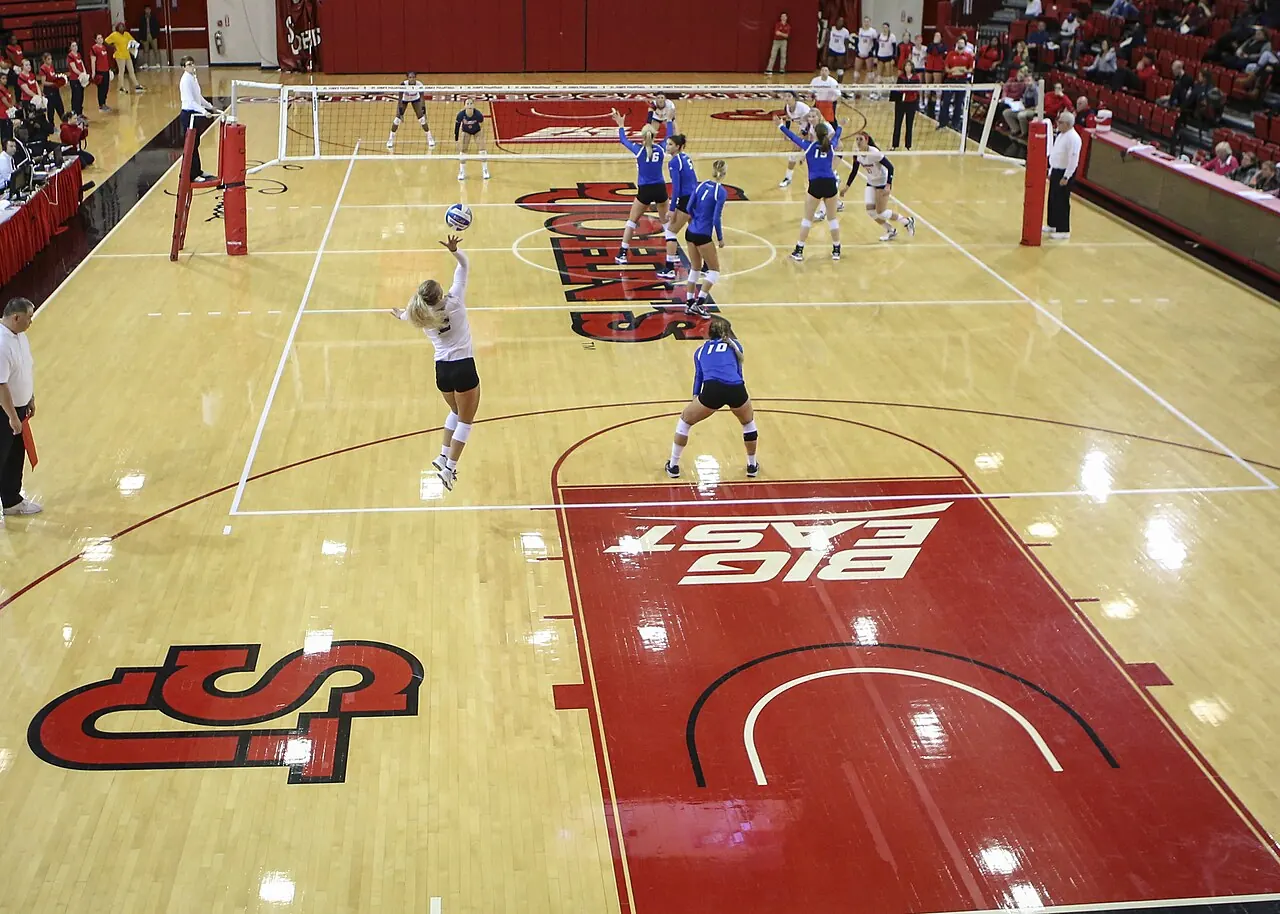
Image source and license
- Original photograph
- St. John's Red Storm women's volleyball vs. Creighton Bluejays.jpg
- Source address
- https://commons.wikimedia.org/wiki/File:St._John%27s_Red_Storm_women%27s_volleyball_vs._Creighton_Bluejays.jpg
- License address
- https://creativecommons.org/licenses/by-sa/4.0
- Preparation
- Full frame retained; resized and converted to WebP for the web. Image remains available under its source license.
In this guide
Route one: automatic qualification
An automatic berth goes to the representative produced by an eligible conference's qualification process. Check the conference's current rules to determine how that representative is chosen. In leagues with a qualifying tournament, the tournament outcome can be decisive; another league's process may differ.
Do not assume that finishing first in the regular-season standings always settles the NCAA berth. A conference can recognize a regular-season champion and also stage a tournament with its own consequences. Those titles and the automatic invitation need to be distinguished carefully.
The NCAA's championship ticket guide describes automatic qualifiers as one part of the field, with the remaining places filled through at-large selection. Use the final championship materials for the season's exact allocation rather than copying a number from an old bracket article. [2]
Route two: at-large selection
At-large invitations fill the remaining places after automatic qualifiers are accounted for. A team can lose its conference tournament and still be considered through this route. Conversely, a respectable record or a familiar program name does not create an automatic entitlement to selection.
The important shift is from a conference race to a national comparison. The committee is evaluating candidates that may have played very different schedules, in different leagues and in different locations. A simple win total cannot describe all of that context.
A useful fan discussion therefore asks what a team's results demonstrate. Which wins strengthen the case? Which losses create concerns? What do comparisons with other candidates reveal? Those questions are more informative than declaring that a particular number of wins must always be enough.
What the committee considers
The 2026 manual lists RPI, head-to-head competition, common-opponent results, significant wins and losses, and KPI among its primary at-large criteria. It also describes secondary considerations and eligibility requirements, including an overall record of at least .500 for at-large consideration. Those requirements establish consideration, rather than guaranteeing selection. [1]
For readers, the practical lesson is to avoid reducing the process to one number. A ranking can organize the discussion, but it does not make the rest of the evidence disappear. The closer the comparison, the more useful it becomes to inspect the underlying results.
Our RPI and rankings explainer separates the different lists you will encounter. Keep their dates visible, particularly when comparing a current record with a poll published earlier in the month.
Why conference standings are only part of the picture
Conference standings tell you how teams are performing within their league's schedule. They are useful for conference titles and tournament placement. They do not necessarily give a complete national comparison because leagues and schedules differ.
Imagine two hypothetical teams with similar conference records. One has several strong nonconference wins; the other has not produced comparable evidence outside its league. A standings table alone hides that difference.
The reverse can happen too. A demanding conference schedule can make a team's record look ordinary while exposing it repeatedly to strong opposition. The proper response is to inspect the full case, rather than awarding credit simply for the league badge or dismissing the record without context.
What a “quality win” should mean in a conversation
Fans often use “quality win” as if everyone agrees on a fixed definition. Before debating it, identify the system being used. A win over a ranked opponent in one list may look different when the opponent's full season or another evaluation tool is considered.
Use the opponent's relevant standing and the date of the information. A preseason ranking does not necessarily describe the team at selection time. Likewise, a team can improve or struggle after an early meeting.
Be specific rather than decorative. “This win adds evidence against a strong candidate” is more informative than “statement win” without explanation. The point is to understand how the result helps the comparison, not merely how exciting it looked on television.
Why an automatic qualifier can affect the bubble
An unexpected conference tournament winner can create a new automatic qualifier. Whether that reduces the room for other at-large candidates depends on what happens to the previously favored team's selection case.
If both teams ultimately enter the field, the outcome can matter beyond their conference. That is why a fan of a bubble team may pay close attention to a tournament involving programs they have barely watched all season.
Do not describe every upset as “stealing a bid” without checking the wider situation. The effect is conditional. A careful projection identifies the assumption behind that phrase and revises it when the official field is announced.
Qualification does not guarantee a seed
Getting into the tournament and receiving a seed are different achievements. A team can enter as an automatic qualifier or at-large selection without being among the seeded group. Another team can receive both an invitation and a favorable hosting position.
For a fan waiting on selection, those stages can arrive within seconds of each other on the reveal. Keep them separate in your notes: selected, seed designation, host site and first opponent. That prevents a confusing reaction to a bracket graphic.
Read our seeding and hosting guide for the next layer. Once selection is secure, placement can influence travel and the potential sequence of opponents, but the matches still decide advancement.
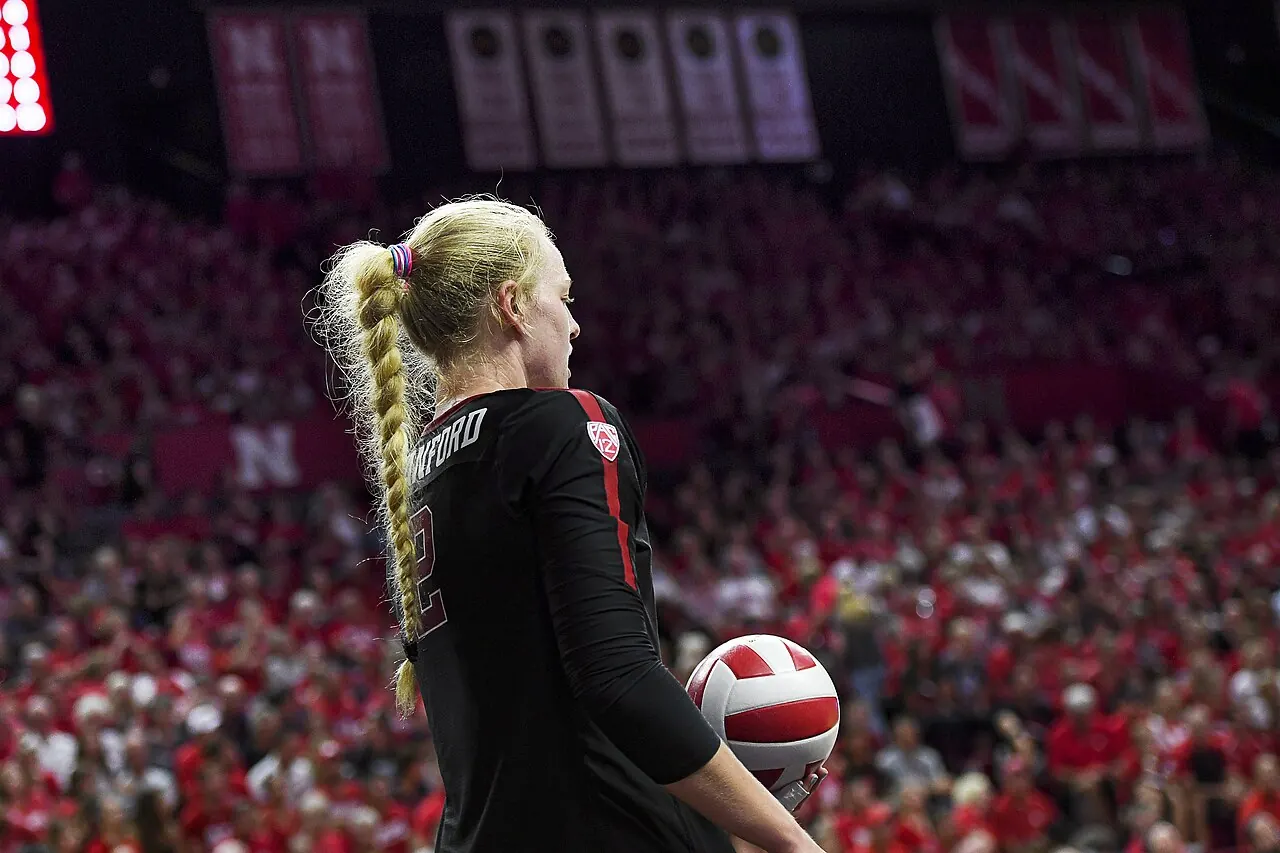
Image source and license
- Original photograph
- Kathryn Plummer Stanford v Nebraska 2019.jpg
- Source address
- https://commons.wikimedia.org/wiki/File:Kathryn_Plummer_Stanford_v_Nebraska_2019.jpg
- License address
- https://creativecommons.org/licenses/by/2.0
- Preparation
- Full frame retained; resized and converted to WebP for the web. Image remains available under its source license.
What to watch in the final weeks
Start with your team's actual remaining schedule. Identify which matches could add evidence that is currently missing and which results would create a setback. Do not turn every fixture into the same generic “must-win” declaration.
Then follow the closest comparison teams and the conference qualification races. The selection picture can change even when your team is idle. A useful update acknowledges that wider movement rather than presenting the résumé as if it exists alone.
Our team schedules and scores can help organize tracked fixtures and results. Use official school, conference and NCAA materials to verify the details that drive a selection argument.
A simple way to read an at-large case
Write three short columns: strengths, concerns and remaining opportunities. Put actual results and comparisons in the first two. Put unplayed matches in the third so an attractive future schedule is not accidentally counted as an accomplishment.
Keep the language conditional. “A win here would strengthen the case” is different from “this team has already done enough.” Both can be reasonable opinions, but they should not be presented as equivalent statements.
Revisit the note after meaningful results. If the prediction changes, explain which evidence changed it. That habit produces better analysis than quietly replacing a team list and claiming the revised version was obvious all along.
Common qualification myths
An AVCA ranking is not an automatic invitation. A strong conference finish is not a universal substitute for checking that league's qualification rules. A historic program's reputation does not put its name into the current bracket by itself.
Another mistake is treating an October committee release as the final field. An in-season assessment reflects the evidence available at that point. Results afterward can change the case, and the official selection date still matters.
Finally, do not confuse eligibility with selection. Meeting a minimum condition allows a team to be considered under the relevant rules. It does not guarantee that the team's comparison will be stronger than the alternatives competing for the remaining places.
Keep a conference-title checklist
When your team approaches the end of league play, write down which title is being discussed and what it awards. Is the conversation about first place in the regular season, a tournament championship or the conference's NCAA representative? Those labels can overlap, but they should not be treated as interchangeable without checking.
Then identify the next confirmed match and any remaining conditions. A team can be close to an outcome without having secured it. “Can clinch with a win” and “has clinched” are different reports.
This is a useful habit even for experienced fans because qualification structures can change. Start with the current season's conference explanation rather than assuming that the route you remember from a previous year still applies.
When the answer becomes official
The 2026 selection show is scheduled for November 29 at 6 p.m. ET on ESPN. That is when predictions give way to the announced field and bracket. ESPN's programming release confirms the appointment. [3]
Before the show, check your viewing access and keep your team's schedule available. After the reveal, verify the first opponent and host through the official bracket, then look for the school's practical ticket and match information.
The whole process is easier to follow once you keep the stages distinct: conference qualification, at-large comparison, selection, seeding and play. A team first needs a place in the field. Everything about its path comes after that.
Sources
- NCAA: 2026–27 Division I women's volleyball prechampionship manualhttps://ncaaorg.s3.amazonaws.com/championships/sports/volleyball/d1/women/2026-27D1WVB_PreChampsManual.pdf
- NCAA Tickets: Road to the championship and selection processhttps://www.ncaatickets.com/womens-volleyball-road-to-the-championship
- ESPN: Confirmed November 29 selection specialhttps://espnpressroom.com/press-release/espn-expands-womens-sports-sundays-franchise-into-fall-2026-anchored-by-college-volleyball-and-nwsl/