
Analysis & Predictions
NCAA Volleyball Tournament Predictions 2026: Teams on the Bubble
Sources reviewed ; current research and later results are reflected in this review.
October volleyball predictions are most useful when they show their working. A confident list of 64 teams can look authoritative while hiding the date, the evidence and the assumptions behind it. This is an editorial bubble watch reviewed October 24, 2026, rather than an official bracket or a claim to know the committee's decisions.
The central prediction is modest: selection pressure will not follow the coaches poll in a neat line. Some teams outside the poll have stronger tournament evidence than their visibility suggests, while some familiar names still need to improve the substance of their case.
Our watch list focuses on Illinois, Georgia Tech, Miami, Utah and Oklahoma, with Michigan State treated as a stronger comparison case. These are editorial categories for tracking the next stage of the season. They are not a published NCAA cut line or a statistical probability model.
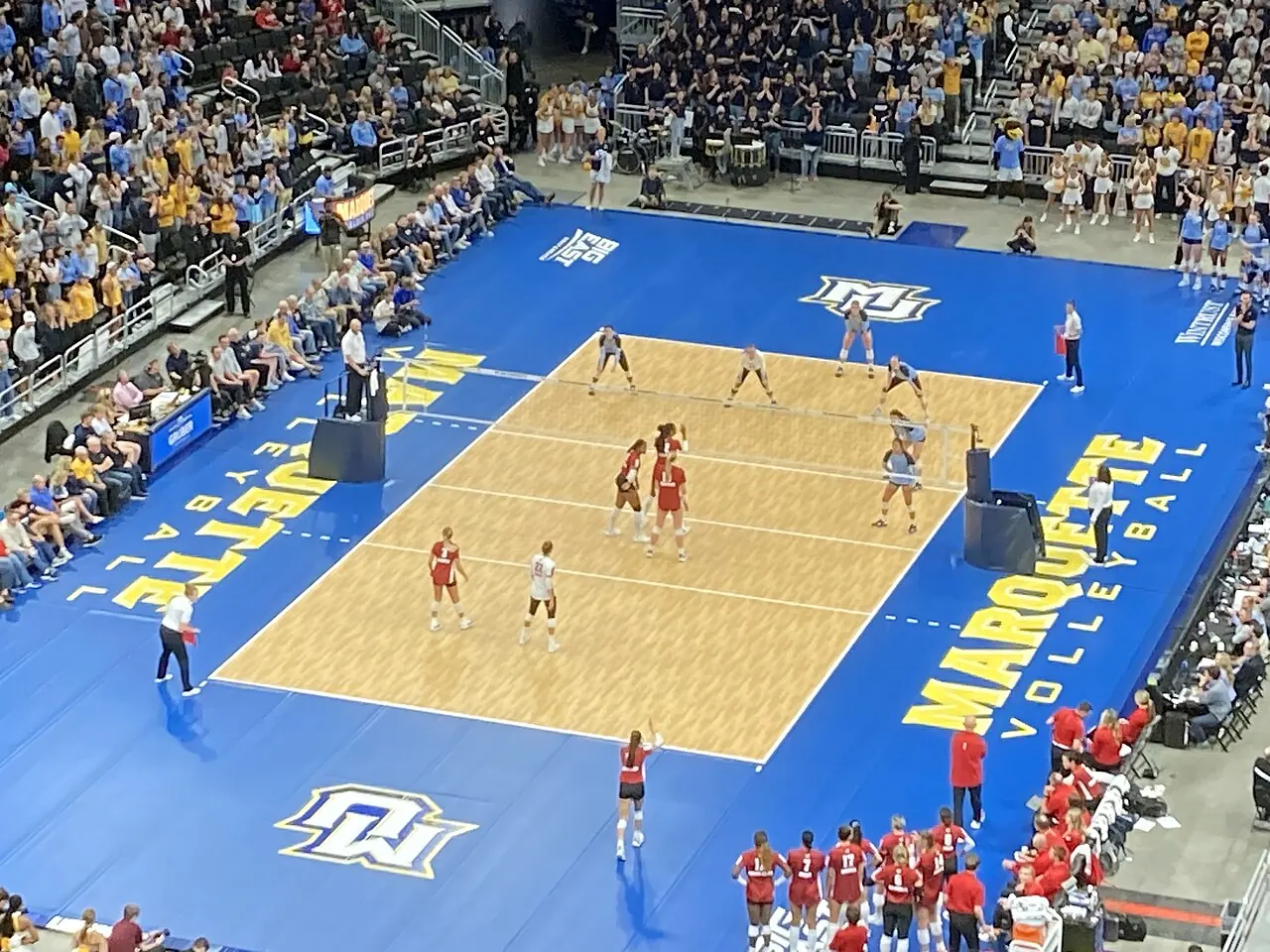
Image source and license
- Original photograph
- Wisconsin vs. Marquette women's volleyball 2023 14 (in-match action).jpg
- Source address
- https://commons.wikimedia.org/wiki/File:Wisconsin_vs._Marquette_women%27s_volleyball_2023_14_(in-match_action).jpg
- License address
- https://creativecommons.org/licenses/by-sa/4.0
- Preparation
- Full frame retained; resized and converted to WebP for the web. Image remains available under its source license.
In this guide
What is confirmed, and what is analysis?
The Big Ten's October 21 weekly release places Illinois at No. 30 in that week's RPI and Michigan State at No. 24. It also notes that UCLA appeared at No. 13 in the committee's in-season top 16 despite receiving votes outside the coaches top 25. Those are dated observations, not current-day guarantees. [1]
The October 19 AVCA poll's receiving-votes group includes Illinois, Georgia Tech, Miami, Utah and Oklahoma. That makes them reasonable names for a broad watch list, but receiving votes is not itself a qualification criterion or proof that a team sits on the last available place. [2]
Everything below turns that context into questions and conditional judgments. We are not publishing invented RPI values, private committee information or unsupported selection percentages. The next meaningful review should follow new results and updated official data.
Why the bubble is not simply the bottom of the poll
A coaches poll and a tournament field answer different questions. The poll expresses voters' rankings at a particular time. Selection compares teams for a championship with automatic qualifiers and at-large decisions.
That means a team can be outside the top 25 without being especially close to missing the tournament. It also means a team receiving national attention can still have a résumé worth examining carefully. Reputation helps a program get discussed; it does not resolve the comparison.
The UCLA example is a useful warning against lazy labels. Calling every unranked team a bubble team would flatten a meaningful difference between national visibility and the committee's dated assessment. The watch list below therefore separates selection pressure from potential seeding discussions.
Illinois: a case worth tracking carefully
Illinois is the clearest starting point for this watch list because the conference's dated RPI information puts the program in a range where the next part of the schedule deserves attention. That is context for analysis, rather than a statement that No. 30 is an official selection boundary.
My editorial lean is to keep Illinois in the active at-large conversation while withholding a “safe” label. The question is whether the remaining work strengthens the case across several comparisons, rather than merely producing a larger win total.
Watch the quality of the wins, the avoidance of damaging losses and how the résumé compares with alternatives. A result against another contender can matter in several ways at once, but one good night should not erase the rest of the season automatically. Use the Illinois schedule to follow the actual fixtures.
Michigan State: a stronger comparison, not a casual cut-line label
Michigan State belongs in this discussion as a comparison case. Its position in the Big Ten's dated RPI summary gives a reason to resist treating “receiving votes” as shorthand for “barely in.” The information available here supports a stronger description than that.
My lean is that Michigan State should be discussed above this article's most uncertain group, provided the remaining results do not materially weaken its case. That remains an editorial judgment. It does not establish a seed or a guaranteed invitation.
The useful next question is what the team can add, rather than whether a poll ranking crosses an arbitrary threshold. A good finish can shift the conversation toward placement and hosting possibilities; a poor finish can reopen selection questions. Check the Michigan State schedule rather than relying on an old record beside a poll.
Georgia Tech and Miami: look past the ACC badge
Georgia Tech and Miami are worth monitoring without treating ACC membership as an answer. The important comparison is the body of work each team builds, including meaningful wins and losses, rather than the visibility of the conference's strongest programs.
My lean is to leave both in a prove-it group until updated official comparisons support a firmer position. That is intentionally more cautious than assigning them opposite sides of a cut line we have not established from complete data.
For Georgia Tech, follow the team schedule and pay attention to what the remaining opportunities can add. For Miami, use its official schedule and results. Do not copy a prediction about one ACC team onto another simply because they share opponents or a conference label.
Utah: distinguish an opportunity from an accomplishment
Utah's presence in the dated receiving-votes group makes the program relevant to a broad conversation, but the votes themselves do not settle selection. The remaining schedule should be read as a set of opportunities still to be converted into evidence.
My lean is to keep Utah on the watch list rather than assign a secure invitation. If the next results add useful wins and improve the comparative case, that judgment should move. If they do not, the availability of tough opponents is not a substitute for beating them.
This is a good place to separate schedule strength from résumé quality. Facing strong teams creates a demanding test. Selection discussion still needs to examine what happened in those matches and how the overall case stacks up against other candidates.
Oklahoma: do not let conference exposure do the work
Oklahoma is another watch-list name, with the same caution about interpreting poll votes. An SEC schedule can provide visible opportunities, but visibility alone should not become a prediction of inclusion.
My lean is to require more evidence before moving Oklahoma into a confident category. The useful update would identify the actual result that changes the comparison, explain why it matters and consider the rest of the résumé alongside it.
Avoid the shortcut that a particular conference deserves a fixed number of places regardless of the teams' work. At-large discussion is about comparing candidates. A program's route can improve through its own results while another contender's route changes elsewhere on the same weekend.
The most important results are not always the loudest
A nationally televised upset attracts attention, but a quieter result can change a close comparison too. A team protecting its case against an opponent it should handle may avoid a damaging setback. Another team may improve its evidence against a common opponent.
When reviewing a weekend, ask what changed in the comparison rather than ranking the highlights by excitement. Did the result add a type of win that was missing? Did it create a concern that the previous projection had ignored?
Do not overreact to one set score. A dramatic fifth set and a straightforward sweep can both count as match results, while the surrounding schedule and comparative context remain important. A prediction should explain why it moved, not simply follow the most memorable clip.
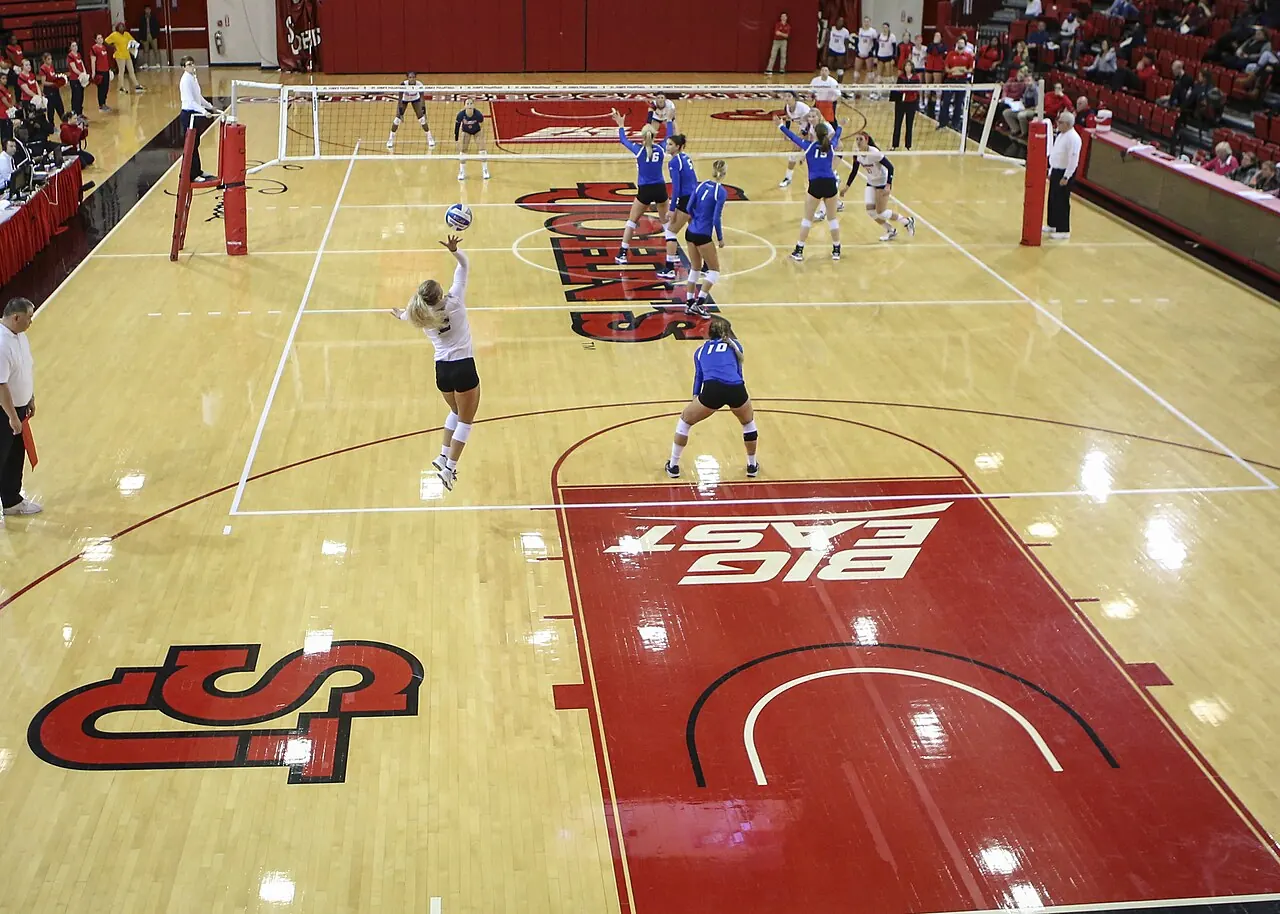
Image source and license
- Original photograph
- St. John's Red Storm women's volleyball vs. Creighton Bluejays.jpg
- Source address
- https://commons.wikimedia.org/wiki/File:St._John%27s_Red_Storm_women%27s_volleyball_vs._Creighton_Bluejays.jpg
- License address
- https://creativecommons.org/licenses/by-sa/4.0
- Preparation
- Full frame retained; resized and converted to WebP for the web. Image remains available under its source license.
Automatic qualifiers can change the available room
A projection must leave space for the teams qualifying through their conferences. When a conference's automatic qualifier differs from an assumed favorite, the at-large picture can change. The effect depends on whether the other team still earns an at-large invitation.
That is why a bubble watch needs to follow conference tournaments and title races outside the most televised leagues. A fan tracking only the five teams listed above can miss a result elsewhere that affects the broader field.
Read our qualification guide for the entry routes. Until the conference outcomes and final selection process are complete, any list should remain conditional.
What would change the editorial tiers?
A move should have an explanation stronger than a team becoming more familiar. For the uncertain group, useful evidence would be additional meaningful wins, fewer unresolved weaknesses in the comparison and updated official information supporting the improvement.
The same standard works downward. If a team loses ground, identify the new result or comparison rather than saying it simply lacks momentum. A quiet week without a headline is not automatically a weaker résumé.
These tiers are deliberately broader than a last-team-in list. They let readers follow the questions honestly while the evidence is incomplete. A later update can become more specific when the data supports that precision; it should not manufacture certainty merely because selection is getting closer.
How this prediction should be updated
A useful weekly update should begin with the review date and the new evidence. It should identify which teams moved, the results responsible and whether a new official ranking or committee release changed the interpretation.
Keep the old reasoning available in a short change note. Do not quietly replace a confident prediction and later present the revised version as if it had always been the view. This article's current analysis is the October 24 snapshot; it does not update itself after each match.
The final test arrives with the November 29 selection show. Until then, treat the watch list as a structured way to follow uncertainty. The objective is better questions and clearer comparisons, rather than pretending October has already decided December.
Sources
- Big Ten: Weekly volleyball central, October 21–27https://bigten.org/news/2026/10/21/big-ten-weekly-volleyball-central-oct-21-27.aspx
- AVCA: October 19, 2026 Division I women's pollhttps://www.avca.org/polls-awards/polls/?_divisions=division-i-women&_season=2026&_weeks=week-8
- NCAA: 2026–27 championship selection manualhttps://ncaaorg.s3.amazonaws.com/championships/sports/volleyball/d1/women/2026-27D1WVB_PreChampsManual.pdf