
NCAA Tournament
NCAA Volleyball Selection Show 2026: When and How to Watch
Sources reviewed ; current research and later results are reflected in this review.
The 2026 NCAA Division I women's volleyball selection show is scheduled for Sunday, November 29, at 6 p.m. Eastern on ESPN. That is 5 p.m. Central, 4 p.m. Mountain and 3 p.m. Pacific. ESPN's published programming announcement and the NCAA's championship manual agree on the date, time and network. [1] [2]
The show is when the tournament field and bracket become official. An October ranking, a projected seed or a television analyst's mock bracket is useful context, but none replaces the selection announcement.
Here is how to watch, what to look for during the reveal and how to turn the bracket into a practical plan for following your team. Broadcast schedules can change, so check ESPN's current listing again near November 29.
Image source and license
- Original photograph
- PittVolleyball2019Pete.jpg
- Source address
- https://commons.wikimedia.org/wiki/File:PittVolleyball2019Pete.jpg
- License address
- https://creativecommons.org/licenses/by-sa/4.0
- Preparation
- Full frame retained; resized and converted to WebP for the web. Image remains available under its source license.
In this guide
Put the correct event in your calendar
Label the reminder “NCAA women's volleyball selection show” rather than simply “volleyball.” That helps you find it among conference finals, match replays and other championship coverage that may appear in search results that weekend.
Use the time in your own zone and keep ESPN in the calendar note. If you live outside the contiguous United States, convert from Eastern time for the actual date rather than assuming the same offset you used in the summer.
Set a reminder early enough to test access before the program begins. Selection shows move quickly when several regions are revealed, and solving a provider login after the first bracket graphic appears is an avoidable distraction.
How to watch ESPN without guessing about the app
The announced network is ESPN. You need access to that network through a qualifying television or streaming package, or a suitable direct plan such as ESPN Unlimited. A subscription limited to ESPN+ content should not be assumed to include the ESPN television channel. [3]
Open the current event or network listing on the device you plan to use. Confirm the active account and any provider connection. If your household has an eligible Unlimited benefit through a provider, investigate activation before buying separate access.
Avoid choosing a subscription based only on the app name. The ESPN app can display events requiring different entitlements. The useful question is whether your account can play ESPN's live network coverage at the announced time.
What the show will make official
The reveal establishes the selected teams, the bracket placement and the initial tournament path. For a fan, the important details are the opponent, seed designation, host site and the other teams in the same opening-weekend group.
Write those details down as the bracket appears. A team can be selected without hosting. A seed number within one region also needs context before you compare it with a number in another region.
Keep an official bracket page available once the NCAA publishes the 2026 field. Until then, treat brackets described as projected, predicted or mock as analysis. Our postseason hub is a planning starting point, not a substitute for the official selection release.
Qualification and seeding answer different questions
“Did we get in?” and “Where were we placed?” are separate questions. Qualification determines whether the team participates. Seeding and bracketing determine the structure of its path once it is in the field.
That distinction helps explain why two fan bases can have very different reactions during the same show. One is waiting for an at-large invitation; another expects selection and is watching for hosting and regional placement.
Do not interpret an unseeded placement as a prediction that the team cannot win. Tournament design describes how the field is arranged. It does not play the matches. Our qualification guide explains the entry routes in more detail.
Read one opening-weekend group at a time
When your team appears, identify the host and the other three teams associated with that site. Start with the first opponent. Looking immediately at a possible regional final can cause you to miss the practical information for the opening match.
Check whether your team is actually the host or merely playing at the host's site. Those situations lead to different ticket searches, travel plans and expectations about the crowd. A familiar program name on the graphic does not necessarily mean its home building is involved.
After the reveal, use the host's official tournament information for session times and tickets. The bracket establishes matchups; it may not answer every operational question at the moment it first appears on television.
What to do if you are following a bubble team
Keep the whole picture in view. A projection published earlier in the week can be overtaken by later results and automatic qualifiers. Do not treat a prediction's “last four in” label as a selection decision waiting to be rubber-stamped.
If your team is selected, record the first opponent and host before debating the placement. If it is not, wait for the official field and any committee explanation before repeating a claim that a particular metric guaranteed inclusion.
For the run-up, our October predictions article labels its date and editorial judgments. It is a snapshot to help frame the discussion, rather than a live feed of committee decisions.
Do not rush into tickets from a television graphic
Once the host site is confirmed, open the school's official ticket information. Check the exact venue, session coverage, sale timing and whether existing season-ticket arrangements have any relevance. Do not assume a regular-season ticket automatically covers NCAA competition.
For a road trip, check both the match date and the session start. A tournament ticket can involve more than one match, and the team's own first serve can depend on an earlier contest finishing.
Keep receipts and delivery instructions together. If you buy for a group, confirm whether seats are together and how tickets will be transferred. A few extra minutes of checking are more useful than winning a race to buy the first listing you see.
Make travel plans in stages
Before selection, research flexible options rather than treating a predicted host as final. After the bracket is official, confirm the first site and dates before committing to transport and accommodation.
Separate the opening weekend from later rounds. A team advancing does not automatically mean its next match stays at the same building. Hosting and bracket outcomes can change the travel question from one week to the next.
Build a little room around the match itself. Volleyball does not have a fixed game clock, and a later session can inherit delays. If the trip only works with an immediate exit and a tight connection, reconsider the margin before booking.
If you miss the selection show
Go directly to the NCAA's official bracket coverage once it is available. You do not need to reconstruct the field from social media screenshots, cropped graphics or a video clip that omits half the regions.
Look for a full replay through the authorized broadcaster if you want to watch the program. A short selection reaction video may contain commentary without showing the complete bracket or explaining the access requirements for later matches.
Check your team's official release too. Schools usually package the practical information their fans need around their own selection. Treat that as a useful companion to the NCAA bracket, especially when you are looking for ticket instructions or the first match preview.
A sensible selection-night checklist
Have the live network working before the start. Keep a note ready for the seed, opponent, host and opening-weekend group. Once your team appears, confirm those details against the official bracket rather than relying only on memory.
Then save the host's tournament page and your team's schedule. Check ticket coverage and transport separately. Share confirmed information with friends, including the time zone and any details that remain pending.
Leave the distant rounds as possibilities. It is natural to imagine a favorite matchup, but the next confirmed fixture is the one you can plan around. A clean first-round plan is more useful than a complete itinerary based on four hypothetical wins.
Make a bracket note you can reuse
Create one note with spaces for the first opponent, host, match date, ticket source and the winner's next connection. Fill only the details that have been confirmed. Leave other entries visibly pending instead of guessing to make the note look complete.
That is particularly helpful when several people are planning together. One person can check travel while another checks the official ticket information, using the same confirmed fixture. If a detail changes, update that shared reference rather than passing around several conflicting screenshots.
Keep predictions in a separate part of the conversation. A possible regional matchup can be fun to discuss without appearing in the same calendar as a confirmed first-round match. The distinction reduces confusion once everyone starts making actual plans.
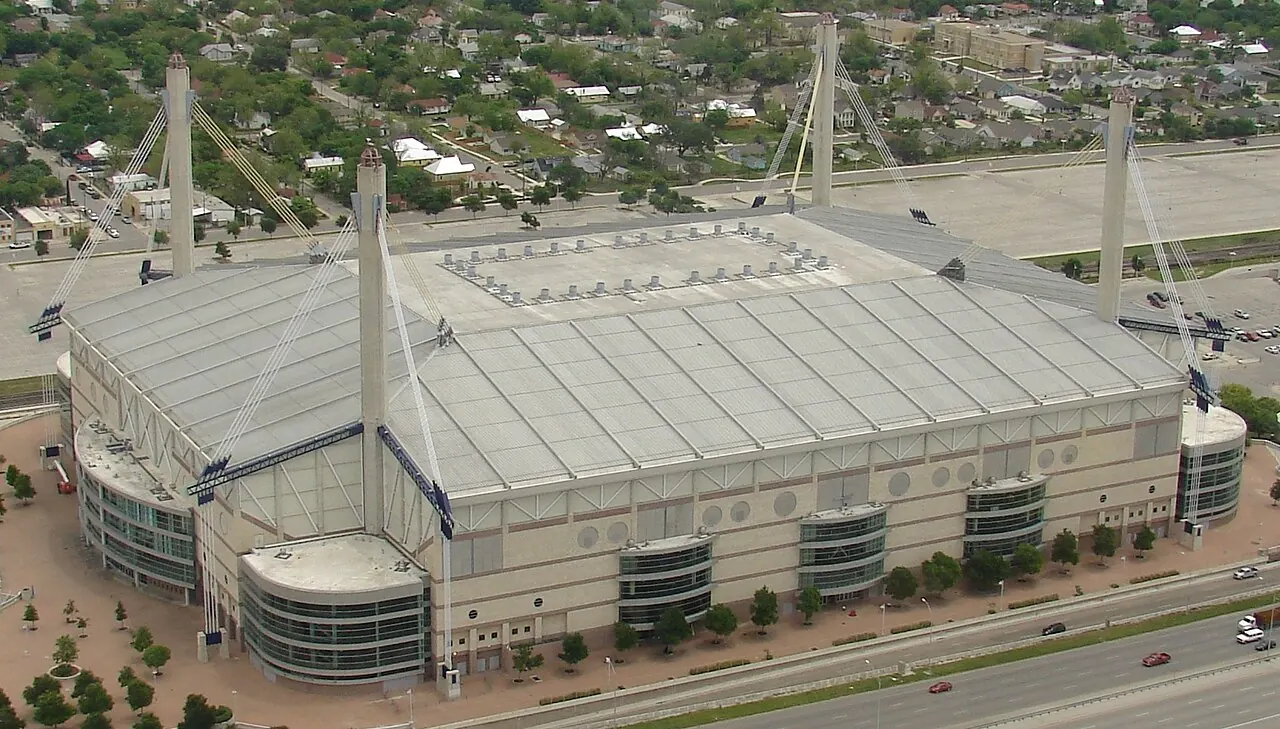
Image source and license
- Original photograph
- Alamodome, San Antonio (1).jpg
- Source address
- https://commons.wikimedia.org/wiki/File:Alamodome,_San_Antonio_(1).jpg
- License address
- http://creativecommons.org/licenses/by-sa/3.0/
- Preparation
- Full frame retained; resized and converted to WebP for the web. Image remains available under its source license.
The December destination is already confirmed
The national semifinals and championship are scheduled for December 17 and 20 at the Alamodome in San Antonio. The NCAA's championship page confirms the dates and location. Those event facts are established; the participating teams will be decided on the court. [4]
If you are considering that trip, read our Final Four ticket and travel guide. Decide whether you want to attend the event regardless of who qualifies or only if your team advances. Those are different budgeting decisions.
For now, the next fixed appointment is the selection show: November 29, 6 p.m. ET, ESPN. Put it in the calendar, confirm access and let the official bracket replace the predictions when it arrives.
Sources
- ESPN Press Room: Fall 2026 Women's Sports Sundays programminghttps://espnpressroom.com/press-release/espn-expands-womens-sports-sundays-franchise-into-fall-2026-anchored-by-college-volleyball-and-nwsl/
- NCAA: 2026–27 Division I women's volleyball prechampionship manualhttps://ncaaorg.s3.amazonaws.com/championships/sports/volleyball/d1/women/2026-27D1WVB_PreChampsManual.pdf
- ESPN: Subscription plans and included networkshttps://plus.espn.com/
- NCAA: Division I women's volleyball championship detailshttps://www.ncaa.org/championship/division-i/womens-volleyball/